Day 233 “The Tao of Giving”

My sister, Mae, is obsessed with yard sales and thrift shops, always looking for the buried treasure amongst other people’s discards.

“I found a beautiful bracelet for Mom,”  she’ll tell me.  “Really, you should see it! Would one of your girls like a purse.  I bet they could use it.  It’s really stylish and only fifty cents!”

Mae is sixty-three years-old and further removed from what is “stylish” than I am, but I don’t tell her so.  Instead, I graciously suggest that they likely have more purses than they know what to do with, being working girls and all.

Mae’s generosity is never without a catch, so recipient beware.  She is so persistent that caught in a weak moment I will relent and accept a gift on behalf of myself or others.  This immediately triggers a flurry of phone calls as to when I will come pick up the illustrious item – as many as six a day.   Once retrieved, she will never ever let you forget the gesture.

“Remember that owl plaque I gave you once?”  you said recently.  “Do you still have that?”

The object in question was a small wooden plaque with an owl engraved into it and some words of “wisdom”.  “I hung it in my first classroom,”  I tell her.  “I thought the message was appropriate there.

“Oh yeah, what did it say?”

I really can’t remember.

“I don’t have room for anything else,”  my Mom will complain, “but I can’t throw anything out because  she looks for it when she visits.”

Perhaps this is a good place to interject that my sister Mae is mentally ill, suffering from schizophrenia.  Giving is her way of connecting to the world.  I have never understood this relentless need of hers, and am equally stymied by the fact that she outright refuses to receive anything from anyone.

“Why would you give me that?  It’s too expensive,” she might say.  Birthday, Christmas, or just because gifts are handed back belligerently or quickly passed on to someone else.  She will not have the stain of taking on her hands.

What has caused this imbalance in Mae? I often wonder.  Yet, if I am honest, I too have never been totally comfortable with the whole giving and receiving concept.   Social etiquette is somehow lost in our family.

Children learn from the example set.   In our family, there was always something sinister lurking behind the act of giving.  Our father, for example, would lavish my mother with new, expensive clothing, but the fact that it usually occurred when she was at the end of her rope and threatening to leave him, was never lost on us.  I clearly remember questioning how he could afford it all at a time when Mom didn’t have enough household money to pay for the basics.  Father’s gifts were clearly a ploy to control her.  I swore never to fall into that trap.

Gifts from my mother similarly conveyed a message.  She would favour one child over another, and excuse it by saying that the child in question had greater need than the others.  Her logic was confusing, if not outright cruel.

Mae’s inability to escape the cycle of unhealthy giving is a symptom of the dysfunction we lived.  She cannot escape.

Escaping and experiencing something different is what I strive for.  Yet, years of guilt for not having given enough to my children, or embarrassment for having missed an opportunity to give to another when everyone else has risen to the occasion, continue to plague me.

“Unattached giving” is the lesson to learn according to today’s reflection in The Tao of Joy Every Day, by Derek Lin (my inspiration for this blog).  To give only what you can spare, and without expectation of return.

“Give a small amount every day…” Lin advises.

Now confined to home with illness, this challenge requires a real shift in perspective on my part.  What is giving?  What does it involve?  If I begin with the assumption that anyone, despite their present circumstances, is capable of giving, then I have to redefine what that means.

I cannot offer to take someone out for lunch, or even get out to buy them a card, so how can I still fulfill this task? What do I have to offer?

Gifts, I decide, come in many forms, and are defined as much by the joy that they bring, as they are by the value they hold for the person giving.  So what do I value right now?  Well, I value my energy (as it is limited), and I value my writing.   I am a good listener, and I will share whatever I can to brighten someone’s day, but I am constantly learning the importance of boundaries, so to give more than I have, energy-wise, has  immediate and devastating repercussions on my health.   Reaching out, if that is the gift I can give, has to be sparing, and I somehow have to learn that this is good enough.

Boy, this “Tao of giving” stuff is not as easy as it sounds, and I surely, have lots left to learn.


Day 232 “Levels of Virtue”

“Good, better, best.  Never let them rest.  Until your good is better and your better best,” my father would make me recite often; a constant reminder that I was never good enough.

“Patience is a virtue…, ” my mother would wag her finger at me implying that I was somehow sinful.

I gave up being virtuous long ago.

I don’t know about you, but I’ve always been leery of “good” people.

I knew a woman once who was touted by others as a guru – saintly sweet, full of love and light – you know the kind.  She often rented space in the same office building where I was working at the time, and for some reason, I kept my distance.

Call it instinct.

Or maybe, it was because I didn’t want her judging my lack of virtue.

One day, as I approached the building, I heard a distinctly female voice raised in anger, coming from inside the lobby.  I hesitated, not wanting to walk into the middle of a fracas, and listened for distinguishable voices.  I caught the low, gruff tone of one of the landlords, and the higher, more nasal,  and still calm voice of his partner.  Whoever they were trying to discuss matters with was having none of it – her voice like piercing shards of glass was bouncing off the walls, and as it did not seem like it was going to subside, I had no choice but to push open the door and disturb the scene.

Red in the face, foaming from the mouth, was the “guru”.  Unforgiving of my untimely entrance, she turned her wrath on me:  “Could you not have waited?!  Does no one have any sense of boundaries around here?”  Then she stormed out the door, leaving three brow-beaten people in her wake.

“What was that?”  I asked looking at my befuddled landlords.

“Woke up on the wrong side of the bed, I think.”  chuckled one.

“Apparently we did something to disturb her,” stated the other.   “Nothing that would provoke that amount of anger, I should think, but there was no talking about it with her.”

I had no reasoned response.  After all, she was the purported paragon of virtue, certainly not me.


The River

There’s a river runs between us,
you and I.
Our thoughts, like tears, are liquid
carried effortlessly by the current.

But you and I,
we stand on the banks, oblivious;
ignoring the connection,
proudly touting our individualism.

Still the river flows,
and all you’ve suffered,
and all I’ve suffered,
or dreamed, or imagined, or hoped,
flows with it.

Step into the water with me,
feel our connection,
do not be afraid.
for it is sacred.

Wade deeper and know
you are not alone
for I am here
in this river
that runs between us.

( Image:  ldsmag.com)

Day 219 “Return to Emptiness”

“We’ll give him a few more minutes, shall we?” The kindly old man seated across from me, crossed one leg over the other and sat back as if he had all the time in the world to wait.

“The thing is…I mean…,” I hung my head in shame. “I don’t think he’s coming.”

“Ah, yes.” He picked up his note pad, uncrossed and leaned forward. “I suspected as much.”

“He went away for the weekend, you see, and he hasn’t returned yet.” How could I tell him that my husband left on Friday, and this was Monday, and I hadn’t heard a word from him? “He knew about the appointment,” I scrambled to make an excuse, “he just wasn’t sure if he’d make it back on time.”

“Do you think he wanted to be here?”

The question hit me hard. Tears caught in my throat and the best I could muster was a silent shake of the head.

“I’ve been doing this job for a long time, and I really don’t see any point of beating about the bush,” the psychiatrist said reaching for a tissue. “The fact is you and I both know he never had any intention of coming here today. He’s left it in my lap to tell you the marriage is over.”

It was the first of December, and when my partner of seventeen years did return home, he confirmed the doctor’s conclusion.

“We’ll wait till after Christmas,” he declared matter-of-factly. “That way we won’t ruin the children’s holiday.”

I hadn’t seen it coming. The shock was replaced with a overwhelming numbness that spurred me into robotic overdrive. Maintain a semblance of normalcy, I kept telling myself. No one must know! Secretly, I think I was hoping that if I acted like nothing was happening, then nothing would happen.

Inside, I was a mess. I had built all my hopes and dreams around this man. Seventeen years is a long time to commit your life to another, and frankly, I didn’t know what else to do.

The days passed, and in a fog, I trudged through, looking for meaning to the madness that surrounded me.

I just want some joy in my life, I prayed. How do I feel alive again?

The answer came during an ordinary outing with my children to the local library. I loved the library, because after I’d settled the kids in with some books of their own, I could search for myself. “Read; it will help keep you distracted,” my psychiatrist had advised. No arguments there.

Abandoned on a partially empty shelf, a little book caught my eye. “Everyday Sacred” was the title and the picture was of a large, red, earthenware bowl. I picked it up and flipped to the preface. It read:

bowl

I scooped the book up, then my children, and waited anxiously for the moment to explore Sue Bender’s words.

My soul resonated with the analogy of the bowl. My bowl had suddenly been emptied, and I would have to create a whole new beginning. Bender described the spiritual act associated with a begging bowl, in which the bearers would have to go into the streets and beg for their daily meals. The lesson: to learn to accept what we are given, each day, and to cherish all offerings. (My simplified version.)

Something inside me sang. I wanted to learn to live with gratitude and the joy of beholding the sacred in everyday.

Plans for the move started to take shape. As my husband worked from home, the children and I would move out. We found a townhouse not far from their school, and I ran into an old friend who was in the process of downsizing – she furnished the house for us. It was almost as if the Universe was stepping forward to buffer the blow. While my heart still ached, and I could barely manage to eat for the stress of it all, I also felt strangely comforted. My proverbial bowl continued to flow with abundance, and I just kept giving thanks.

Moving day was drawing near and the last thing I had to do was to arrange for a new home phone. Something in that act felt final, and as I hung up from the customer service rep, I put my head down on the table before me and felt the full weight of grief. There would be no going back. My life as I’d known it was over.

Look at what it spells. I swear a little voice whispered in my ear. “What what spells?” I spoke aloud, looking around for the source, but no answer came. Convinced I had really lost it, I turned my attention back to my new phone number. I would have to memorize it.

2 – 6 – 9 – 5 were the last four digits. 2, 6, 9, 5, I repeated in my head. 2695. Could this spell something?
I checked my keypad. And there it was:

b – o- w- l.

With no steady income and three mouths to feed, I had live with what each day brought, sometimes hardship, and sometimes blessings. It was a humbling, yet soul inspiring time of my life.

* * *

It’s been seventeen years since Susan Bender’s writings came into my life, but the concept still resides with me, bringing me comfort.

Now learning to live with chronic illness, my life has been once again emptied of the sense of purpose and routine that I had become so attached to.

I have returned to emptiness, and because of it, I now have a whole vessel waiting to be filled, and each day, I take what I’ve been given, and give thanks – for once again the simplest of things have become – every day –  sacred.

(Sue Bender’s book is available on Amazon. Click here for a copy.)

Day 216 “Living with the Unknown”

“We don’t know what causes this illness, and there is no cure or course of treatment other than management, and that is mostly trial and error.” It is the standard answer from all healthcare providers when it comes to ME/CFS.

“I am flat out frustrated,” I tell my therapist. “I can’t seem to find a regime that works. I can have one or two good days and then, wham, I am knocked down for no apparent reason.”

“That seems to be the way with this disease. How are you managing emotionally?”

“Okay, mostly, but on the worst days I find myself always on the edge of tears.”

“There is a grieving process that accompanies a diagnosis of chronic illness, you know. It has to do with the loss of your normal life, and all the things that go with being healthy.”

“This feels more like fear. I know it’s irrational, but this feels very much like fear.”

“Are you afraid you’ll never get well again.”

“Nnnoo…….I know I can do that – I’ve gotten through worse before. It’s just….it feels almost as if it’s coming from an old place – a younger me, if that makes sense.”

“It does actually. Whenever we are hurt or vulnerable, we often respond from a wounded part of ourselves, and that usually relates back to childhood. How old does this make you feel?”

“Nine!” I respond immediately. “I can see me, sitting in the corner of my childhood bedroom. It was my favourite hiding place. I spent hours and hours there as a kid.” Wishing someone would come find, but they never did, I remember to myself.

“Can you talk to her?”

Little Me sits with her knees drawn up tight, arms hugging them to her, eyes wide open and hyper-alert.

“What is it?” I ask.

No one will want us, her fear says.

The emotion hits me violently. She was told over and over again that she was an unwanted burden. “Unwanted” is the key word. We can handle any other pain than that.

“We have a burden complex,” I tell both her and my therapist.

Both nod, but Little Me’s terror and tension doesn’t ease.

“Go on,” urges my therapist.

“A burden is something, not someone,” I explain. “You are not a burden. You are a child, and by that fact alone, you have certain rights – birthrights – among them the right to have your needs met, the right to be looked after and cared for, and the right to be loved. NOT: You have to earn these rights! NOT: You are unworthy and therefore undeserving! You exist, you are born, those are your rights!”

My therapist nods throughout, and more importantly, I see Little Me is listening, and her shoulders have dropped a bit.

But Mom says…., she begins.

“I know what your Mother tells you: Don’t wear out your welcome. All she means is be polite and stay a reasonable amount of time when visiting your friends. She is not commenting on your likeability.”

Really? What is a reasonable amount of time?

“Discreetly leave before supper is ready unless you are invited.”

“Yes, yes,” the therapist nods.

Little Me considers this. Then why does she rush us off to bed at night as soon as Dad gets home? Isn’t it because we’re a burden and she doesn’t want to remind him?

“NO! It has nothing to do with that! I cannot emphasize this enough! It is something you will understand as an adult, but for now, know that you being sent to bed is your parents’ issue, not yours!”

What about Thor? Won’t he find us a burden and leave us?

“Ahh!” says my therapist warmly.

I feel my throat catch and sigh. “Some things in life are uncertain.” It’s not like I haven’t thought about it. How do I begin to address this? “We have many things that Thor is looking for,” I offer. “Last year, we looked after him. We are patient, loving, and good listeners. These are important to him. He is wounded too, you know. He needs reassurances. Our insecurities will push him away more than anything, especially if we pretend not to have any.”

The truth of this last statement hits me. Little Me loosens her posture and now looks at me quizzically. Confession time.

“One of the things I have done in my life – right or wrong- is to develop a tough exterior. It hasn’t always served us well. Much like our Mother sending us off to bed early, I did it as a form of protection.” I pause to feel the weight of the revelation. “It doesn’t work anymore.”

The silence from within and without encourages me to go on. “Part of my healing process – our healing process (I add for Little’s sake)- is to replace that characteristic with a healthier one.”

What will that look like? Little Me echoes my therapists thoughts.

“Not entirely sure, but I know how it will feel: safe enough for you to come out of the corner and engage with life. You, we, have a lot to share, and we can’t do it when we hide ourselves away.”

I am strangely comforted by this conversation: lighter. “I have my homework cut out for me,” I tell my therapist.

“You do! But this is a good start.”

“Life is full of uncertainties,” I tell Little Me, on our way home. “Some good, some bad; it’s just the way it is.”

Kinda like an adventure?

“Yeah, it kinda is!”

Day 214 “Divine Spark”

The emerald waters
of my crystalline personality
are only a reflection
of an external light.

Lurking below the surface
the murky waters
of self-deprecation
create further illusion.

Dive deeper,
beyond the cold chill
of darkening thoughts
and threatening despair

Weed through the silt
of bottomed out desires
and find an opening –
black and foreboding.

Enter with an open heart
and find the chest within
rusted from neglect,
unguarded, with open latch.

Brush away the cobwebs
and with respectful caution
lift the dusty lid
and behold the divine spark

My true essence,
Tucked there in the darkness
an eternal flame
vibrant and vital.

Release it for me,
be so kind,
to light this dismal patch
and set my waters aglow again.

So that the emerald waters
of my crystalline personality
would reflect my inner
divine light.

Day 213 “Life After Life”

“Scoot up on the step, Rie-Rie, and let Mommy put on your new shoes.” With only weeks to go until my second child was to be born, I found bending over impossible. Obligingly, Marie climbed up the steps and offered me a foot. “Look how shiny they are! Don’t you love them?”

The black patent Mary-Janes fit her tiny feet perfectly. She sat patiently while I adjusted the buckles, chattering away as she often did, but this time I found her words strangely unsettling.

“When you were little you always loved your Baby Dolls the best.”

Baby Dolls! It was a term I hadn’t heard for ages.

“Where did you hear them called Baby Dolls?” I quizzed my two-and-a-half-year-old.

“You called them your Baby Dolls. You had to wear them everywhere.”

Marie often talked of when she was big and I was little; I had just thought that it was a thing that young children did. When you were a baby, I fed you applesauce, she’d say, for example. But repeating a name I’d left behind in my own childhood and forgotten startled me. Who are you? I wondered.

My second daughter was born at the end of October, the same day we moved into our new, unfinished home. Without kitchen cupboards, or a proper countertop, I was forced to bathe my newborn in the bathroom sink. I assigned Marie as helper and stood her on the toilet seat where she would be within reach. On the back of the toilet, I had placed a flower arrangement, made from the silk flowers that had been part of my bridal bouquet. Marie spotted it at once.

“Oh, how pretty!” she exclaimed. “I made one of these once.”

“You did? And when was that?” I couldn’t help but be amused. In her short life, at home with me, I knew for certain she had not.

“Oh a long time ago, before you were born. Only I made it out of yarn.”

Yarn?! Where did she come up with such things. I would say ‘wool’, not ‘yarn’.

“Oh yeah? And where was that?”

“It was when I lived in England. At school.”

“And how old were you then?”

“Sixty months.”

“And how old is that?”

“Five.” Marie said it so matter-of-factly, but I was stunned. How does a not quite three-year-old know that sixty months equate to five years?

“Marie is scaring me with the way she talks,” I told my mother over the phone. “It’s like she has been here before.”

“You were like that too,” was her response. “She is just very bright, that’s all.”

I wasn’t so sure. I called my cousin Lynne. “Could she have been here before, like she says?”

“Some people believe so,” she said. “It’s called reincarnation. There’s a book you should read that might help you out. It’s by Ian Currie – You Cannot Die.”

It was the beginning of a shift in the way I thought about life, and life after life.

Day 212 “Dharma”

“Let’s start by completing this reading and writing survey,” I suggested to the tall, lanky young man who had recently been placed in my care. Uncertain as to whether or not he had any literacy skills, I offered to read over the lists with him. “We’ll place a check mark beside any or all that apply.”

“Sure thing, Mrs. E.” Mark gave me that charming smile that he was famous for. Although his criminal record was longer than his academic one, Mark was a very likeable young man.

“Which of the following do you read? Magazines?”

“Sometimes. Motorcycle ones mostly.”

“Good.” I wrote that down.

“Newspapers?”

“Not so much. I’d rather watch it on t.v.”

“I’d have to agree. Letters? This must be an old list….” I started to apologize.

“Oh no! I read letters all the time.”

“You do?” I couldn’t even remember the last time I’d received a letter. “Who writes to you?”

“My boy, Ace.”

“Really?”

“Yeah, he’s serving time for assault.”

“Do you write back to him?”

“Of course. We’re tight, Ace and me. He’s like a brother. I’ve known Ace since we was kids.”

Good to know. Mark has literacy skills. I checked off letters under the writing column.

Hovering over the journal box, I asked if he ever wrote a diary or journal.

“I’d like to,” Mark said, “but who would ever want to read what I have to write.”

It was the opening I needed to hook Mark into learning. I was charged with helping Mark obtain a credit in English and Math. Math was easy, as he liked the subject and demonstrated a natural ability; so English was the challenge. We decided that Mark would read a memoir and I would construct relevant writing exercises that would form the basis for Mark’s own personal blog / journal. Mark and I were both excited about the prospect.

What ensued were many hours of heart to heart talks. Mark, the youngest child of a broken home, had been left to his own devices at an early age. He stop attending school in the seventh grade and quickly began to wander with a rough crowd. He confessed that he really did want to turn his life around, but that he didn’t know how. I advised him that while change was possible it would be hard, and might mean a purging of relationships.

“My boys are my family, Mrs. E.” he explained. “Whenever I’ve needed anything, they are the ones I turn to.”

I understood, but I also knew that if Mark was to truly make changes, his friends would have to go.

“Ace is isn’t really his name, you know,” Mark said to me one day out of the blue. “It’s his gang handle. I have one too.”

“You know, Mark, if you sat your gang down, individually, and asked them whether or not they’d like to change their lives, I suspect half would say they did and the other half would be sociopaths.”

“You are right about that, Mrs. E. Take Ace for instance. He comes from a good home; his mom is a professional, and quite successful. His dad is never around, which was part of the problem, but his stepdad’s a good head. He just got off on the wrong foot because of his colour.”

As Mark continued to talk, Ace’s story began to sound all too familiar.

“Wait a minute, Mark. I think I know Ace…or his mother at least.”

He told me Ace’s name and my heart sunk. “I knew Ace as a young man. I knew his mother very well, and admire her deeply. Next time you write to Ace, you let him know I’m thinking about him, and his family.”

I left school that day with a very heavy heart, my last conversation with Ace’s mother echoing through my mind.

“I don’t know what to do,” she cried into the phone. “The police just won’t leave him alone. It’s racial profiling.”

I couldn’t believe what she was saying to me. I didn’t want to. Our city, in these times, capable of racial profiling. That didn’t happen in Canada, did it?

I didn’t hear from my dear friend again after that conversation. Our lives took on different directions, and even though I dropped her a line years later, she didn’t respond. I was beginning to understand why. Her baby was in jail doing time for assault.

“He didn’t do it, Mrs. E!” Mark had tried to reassure me.

Somehow, I believed him. But the story continues to haunt me all the same. Could I have done something different?
Did I let my friend down in her time of need because of my own ignorance.

One thing I know for certain: the world is made up of many interconnecting circles, and sooner or later, what we’ve left behind will catch up with us in one way or another.

Learn from me: Take care of each other in the moment. You don’t know how far-reaching your actions will be.

What I’ve Learned From Trees

Meditating on the majestic beauty of the trees outside my window, I come to recognize something about myself. I cannot help but think that even though they are symbols of quiet strength, trees are not without their own vulnerabilities. Acts of Nature, or even human folly can bring them down, and so they, like me, are not immortal.

th-3Perhaps none of us is meant to be an impenetrable force: the kind of force I aspired to in my youth.

You see, I always thought of myself as a strong woman, however; unlike the trees I contemplated in my last post, I was not flexible – bending graciously to the winds of change – but belligerent, resistant, and arrogant. I was a right fighter. Having grown up in an atmosphere of relentless uncertainty, I commanded myself to be strong, believing that with an iron will, I could gain control of life – not just my own, but the lives of those around me. I adopted an air of superiority – pretending to know better than anyone else – even though on the inside, I never measured up. Showing vulnerability was never an option. Instead, I must have appeared the fool, and undoubtedly hurt many others.

True strength, I realize now, comes in retreating in the face of adversity, and the willingness to see beyond personal righteousness. It involves an openness to understanding alternative perspectives, and the wisdom to perceive the truth underlying the turmoil.

th-4My current life circumstances have brought me limitations: physically and mentally. My awake and energetic times are severely restricted. I am challenged to create a new definition of self, and what it is to be strong.
I dreamt of my dear cousin Bev last night. Bev passed away recently after battling cancer for ten years. In all those years she faced her struggle with a quiet strength: maintaining her outer poise, surrendering to the times of severe illness, and establishing healthy boundaries. She was a model for gracious living. Truly a strong woman.

Illness has brought me an opportunity to retreat for a while. It is allowing me the possibility of real change: measurable change. In surrendering my old sense of self, I will surely emerge new.

In the meantime, I remain open and vulnerable – not comfortable – but then at fifty-six years of age, I am well rooted. Like the trees.

As a Tree

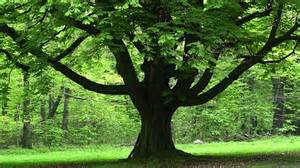
Confined for hours at a time to my bed, I cheer myself by contemplating the trees outside my windows. There is something in their stoic beauty that both calms and inspires me.

Be as the tree a former meditation instructor taught me.

If I were a tree
my roots would run deep into the earth
and spread in all directions
grounding me.

Present.

My trunk would be wide and solid
weathering all storms
supporting other life
a tower.

Strong.

My branches would reach up to the sky
and dance with the breezes
and bend with the changing seasons
and bow to Nature.

Flexible.

If I were a tree
I would be calm, yet strong;
have heightened awareness, yet be rooted in reality.

I would yield to change,
yet stand proud in my own existence,
growing with grace.

If I were a tree
I would live in harmony
with Nature.

Present, Strong. Flexible.

Fully alive.

(Image from: www.nbcdfw.com)