I don’t know if it is because Ric is away and I am feeling the entirety of my dependency, or if it is because it has been a year and there has been no discernible improvement, but I am struggling at present to keep depression at bay.
This disease, which is presently being re-named as SEID (Systemic Exertion Intolerance Disorder) presents a series of challenges that are seldom understood by the general public (or many medical practitioners). In layman’s terms, I would like to describe them here:
1. While the cause of the disease is still in question, there is a consensus that there is a viral component. The immune system, some believe, has exhausted itself in the fight against the unknown invader. Antiviral treatment is recommended, however; many, such as myself, have an intolerance of chemicals, so have to carefully monitor the effects of anything we ingest. While I have always suffered from food allergies and intolerance, I have found lately that this has increased – resulting in immediate skin or food sores.
T-cells, or friendly killer cells, are also compromised by this disease, as discovered by Dr. Klimas of the Institute for Neuro Immune Medicine in Miami. Dr. Klimas’ clinic is currently the only one testing for and treating this aspect of the disease (that I know of). The cost for a Canadian to visit the clinic is $10,000. Please understand that this is for a consult, and commencement of a treatment protocol, not a cure.
2. Widespread inflammation affecting the brain, spinal cord, and muscles.
Mentally, this means that cognitive functioning is affected. Executive functioning – the ability to plan, organize ideas, or deal with complex thoughts – has become difficult (relative to my state of exhaustion), as has working memory – the ability to carry an idea or concept from one application to another. Numbers, for example, are impossible to keep straight. I might see the number 215, but when I try to relay it to another it will come out 415. I constantly mix up dates, appointment times, etc, to the extent that Thor has to keep my personal calendar. Reading and absorbing what I’ve read takes repetitive attempts, and writing is challenged by the loss of words, or recognition of words.
Inflammation of the spinal cord means my nervous system does not function properly. Outside stimulus, such as smells, sounds, or movement, can be overly taxing. My startle reflex, like a newborn baby’s, is on overdrive. Emotions, whether positive or negative, send me into a spin, creating a “wired affect” which disturbs sleep and my ability to rest.
My muscles have become not only weak, but unreliable. In the early stages, before diagnosis, I have would have weird cramping, like Charlie Horse’s, in my legs and feet. Now, the sensations range from tautness and extreme weakness to a deep, relentless pain. I will often stumble or fall, and drop things. I can no longer count on my body to support me, so I walk with a walker for short distances and take a wheelchair otherwise.
3. Orthostatic Intolerance is another factor in this disease. Basically, my body can tolerate standing upright, or sitting, for short intervals only. This makes cooking, showering, or even sitting in the car challenging. I take most of my meals in bed, where I can have my feet raised, and recline the seat when in the car. (Driving is not an option for me right now.) Meals need to be simple and instant, unless someone else is preparing them – and I must say my husband has been a gem!
 4. Exercise (society’s answer to everything) is not so easy for the CFS/ME/Fibromyalgia patient. While some strength training is recommended, aerobic exercise can severely set back any progress. Trial and error is the protocol here, with a technique called ‘pacing’. Pacing involves sandwiching activity with rest, keeping in mind that there is a limited amount of energy available for activities throughout the day. For example, on the days that I wash my hair (now only once per week), I know I will have little energy left for anything else. My doctor suggests setting a timer so as not to overdo anything, an idea I have yet to implement.
5. Lack of restorative sleep. I tend to suffer from insomnia, although this is improving. Originally I would manage 3-5 hours of broken sleep per night, but lately 5 hours seems to be the norm. Still not enough to feel recharged. (I am not even sure if that is possible at this stage.) Compensating with meditation seems to help, the key being to have solid chunks of time without disruption. (No TV, radio, computer, phone calls, etc). This is easier than it sounds.
6. Grief/ depression: naturally with the loss of mobility and normal functioning there is going to be reactive depression. I am generally a happy, content person, but that only goes so far in the face of this challenge. Unable to work, socialize, travel, or even tend to normal household routines, it is difficult to “keep the faith”. Prior to becoming ill, I was passionately engaged with my work and my family, belonging to clubs, taking workshops, and so on. I felt as if my life was going somewhere, and it was exciting. Dropping out of sight means an automatic loss of the things that once brought sustenance: relationships, goals/ planning, and a sense of purpose. (Where is the purpose in being bed-ridden everyday?) Grieving is not easy because it calls for resignation and acceptance, and my soul is not complying. I keep telling myself that this is a big inconvenience that will one day just go away and I can get back to living. Wrong!
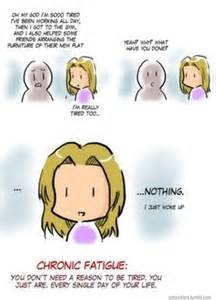 7. Exhaustion. This is not your weary at the end of a full work day exhaustion. It is system wide. Talk on the phone too long, hoarseness signals my vocal chords are tired. Spend too much time on the computer (writing this has been an all day adventure), headaches set in, as well as mental fog. Stand or sit for too long, I feel both my spine give out, as well as swelling in my lymph nodes. Overall exertion – going out for dinner – and I am flattened for a period of time with flu-like symptoms. The more I attempt to live a normal life, the more my system complains. I would like to say that progress out numbers setbacks, however; the reverse it true.
When I told a nurse friend of mine that this disease is more prevalent than breast cancer, her response was “No way! How can that be?” (meaning, how can it be that so little is known about it.)
I have a few thoughts on that matter. Patients suffering with ME/CFS/ Fibromyalgia are often homebound, and therefore, out of sight. They do not have the energy to walk for a cure or rally together for any awareness. This is the invisible disability.
As there does not seem to be one drug treatment that addresses the issues, there is no money to support research (much research is funded by the pharmaceutical companies). In fact, I think this disease is like the proverbial canary in the coal mine – a warning about how toxic our environment and food has become. Who wants to face that?
So, where is the hope? How do I cope and carry on? I follow a very simple regime of diet and treatments:
a. I avoid dairy and gluten in my diet, and wherever possible, processed foods. I did follow a vegetarian diet for four years prior to being diagnosed, but have had to add some meat back into my diet for convenience matters, however; digestion of heavy meats causes severe IBS symptoms. I have minimized caffeine intake, avoid alcohol, and need to work on eliminating sugar.
b. I see a Doctor of Chinese Medicine for acupuncture and herbal supplements. These include a probiotic, an adrenal boost, digestive enzymes, and other supports as needed.
c. I see a specialist to address my allergies and asthma, as this is exacerbated by the disease. I do take prescribed medications, which is constantly monitored.
d. Restorative yoga is a recent addition to my treatment schedule. A private instructor comes to the house and works with me on the bed. I can incorporate this into my twice daily meditation/ rest time. The instructor also gives me homework to improve my breathing and muscle strength.
e. I see a psychologist regularly to ensure that I have support for depression, grief, and any other issues that might arise. (It is amazing how much stuff comes up when you have nothing to do but lay around.)
f. Pacing. As mentioned before, this is the number one recommended approach to maintaining balance. Limiting activities and stimulation is essential for staying out of the crash and burn cycle.
 g. Social time is a very important part of keeping positive. I have a few friends, as well as children, who visit regularly and are willing to lie beside me on the bed if need be. My granddaughters are the best as they love to cuddle with Grandma.
h. Writing is also an important part of my recovery. To be able to remain passionate about something is a gift, and with today’s technology, even when my hands and wrists tire, I can dictate!
i. Music and books on tape are the other stables in my regime. Since my mind doesn’t allow me to concentrate enough for reading, I have found that listening to someone else read is a happy compromise. Podcasts are even better, as they are often short and interesting. Songza provides many playlists of mellow music for relaxing or meditation/yoga. (Note: watching TV is not a good past time, as the combination of sound, visuals, and annoying commercials is overly stimulating. If I do watch, I try to pre-record.)
j. Games and apps. Games that stimulate the brain are good in short intervals. Magic Puzzles provides endless jigsaw puzzles that can be set at easy, medium, or more challenging. ME/CFS Diary is an app that allows the patient to monitor patterns – this is excellent for tracking activities and symptoms to share with the doctor. (I find it easier than filling out the daily paper logs).
k. I have recently started taking short walks every day (five or six houses down the street). The challenge with this (and any exercise) is making sure that I do just enough to make a difference without setting myself back. This is still in the trial and error stage.
I hope this discussion of ME/CFS has been helpful. I welcome comments and further discussion, and would like to reiterate that I am speaking purely as a layperson, and not as a medical expert.
 One Woman's Quest