Nature’s Divinity

Well before I was of an age to articulate it, I understood that there was something sacred about nature. An indescribable presence spoke to me and I, unscathed by the creeds of modern religion, learned to listen with reverence.

My appreciation for a Higher Being was stirred in the gardens of my birthplace. The vibrant colours of the many species of flowers and the busy, other world, of the insects that inhabited these gardens spoke to me of a whole world that was invisible to the ordinary eye. Life within life. I was captivated.

By the age of five, I began to wander beyond the garden gate, across the tilled fields of the farm that our home bordered, and into the woods beyond. There my true schooling began.

The woods were untamed – a tangle of old and new growth, thickly blocking any paths – and if I was careful enough to pick my way through, I came to a natural opening where a creek ran through. The water, like my soul, was clear and revealed every little secret.

For hours, I would squat and behold its wonders: tadpoles in the springtime, crayfish burrowing in the sand, and even the twigs that would be carried by the current, get stuck in the rocks and resist the flow of water until they were released again.

I discerned a certain pattern to the life I was witnessing: a sense of harmony and purpose.

Lucky enough to live in a country with four seasons, I absorbed the lessons of change, and learned to read the signs. The shifting wind, for instance, spoke of brooding weather, or the coming of spring after the winter’s slumber. I learned that life has cycles, and that after every winter comes the rains and new hope of brighter days.

Another of my favourite spots was deep within the woods, where the light beams trickled through the leaves like a cascade of fairy sparkles. Burrowing into the soft soil of the earth, I would sit quietly, patiently, until nature revealed herself to me. The woods, I discovered, much like the garden of my own backyard, housed a thriving population: insects, birds, animals, and reptiles – all whose existence seemed to rely on one another.

I wanted more than to be a part of it all – accepted, belonging: a child of Nature.

And then I lost my innocence.

I attended church, and learned that God lived in a church, and that I was not worthy of His love, and therefore; I needed to repent. I needed to repent because I was blemished by sin, and that felt dirty, and the earth that I so loved became undesirable, and bugs were icky, and nature was something wild to be feared.

I began to doubt my own understandings.

I learned to doubt me.

I lost confidence.

I no longer listened to the signs.

I learned to want for things, material things, anything, that would fill the void. Disconnected from the reverent, life felt out of control, something to be feared, not revered.

But nature has a way of reminding, even the most diehard non-believers, that there is more to life than we can see, and that a force, inexplicable, and sacred exists, and it came knocking on my windowpane tonight, with a message in the form of unseasonal gale winds and hail, and woke me from slumber.

And my soul answered, like the child I had once been, with a joyous recognition that despite all our theories, and doctrines, and delusions of educated knowledge, there still exists a life within a life: the Great Mystery that defies us and keeps us ever humble.


T

What I’ve Learned From Trees

Meditating on the majestic beauty of the trees outside my window, I come to recognize something about myself. I cannot help but think that even though they are symbols of quiet strength, trees are not without their own vulnerabilities. Acts of Nature, or even human folly can bring them down, and so they, like me, are not immortal.

th-3Perhaps none of us is meant to be an impenetrable force: the kind of force I aspired to in my youth.

You see, I always thought of myself as a strong woman, however; unlike the trees I contemplated in my last post, I was not flexible – bending graciously to the winds of change – but belligerent, resistant, and arrogant. I was a right fighter. Having grown up in an atmosphere of relentless uncertainty, I commanded myself to be strong, believing that with an iron will, I could gain control of life – not just my own, but the lives of those around me. I adopted an air of superiority – pretending to know better than anyone else – even though on the inside, I never measured up. Showing vulnerability was never an option. Instead, I must have appeared the fool, and undoubtedly hurt many others.

True strength, I realize now, comes in retreating in the face of adversity, and the willingness to see beyond personal righteousness. It involves an openness to understanding alternative perspectives, and the wisdom to perceive the truth underlying the turmoil.

th-4My current life circumstances have brought me limitations: physically and mentally. My awake and energetic times are severely restricted. I am challenged to create a new definition of self, and what it is to be strong.

I dreamt of my dear cousin Bev last night. Bev passed away recently after battling cancer for ten years. In all those years she faced her struggle with a quiet strength: maintaining her outer poise, surrendering to the times of severe illness, and establishing healthy boundaries. She was a model for gracious living. Truly a strong woman.

Illness has brought me an opportunity to retreat for a while. It is allowing me the possibility of real change: measurable change. In surrendering my old sense of self, I will surely emerge new.

In the meantime, I remain open and vulnerable – not comfortable – but then at fifty-six years of age, I am well rooted. Like the trees.

Self-Delusion

I am driven,
a woman obsessed.
feet digging in,
body pressed forward,
the sweat on my brow
blackened by the relentless dust
whipping around me
in the prairie heat.
I drive on,
fatherless,
husbandless,
solely responsible
for my cargo
the horses heeding my commands,
everything, everyone
I treasure
on board.
I am a pioneer
delivering us
to the promised land.

I am wounded,
bleeding,
my prone body
curled on a mat of straw
back towards the others
teeth clenched
in silent pain
determined
not to show my need.
I will not be a burden.
so I feign sleep
and brace myself
against the jolts
and try not to gasp.
Lie still,
Be brave,
the journey is necessary
and soon we will arrive
and all will be well
and I will stop,
bleeding.

We children
are both afraid and
joyous
The ride is bumpy
and never-ending
and we try to be good
and not complain
but our spirits long
to play
to get out of this wagon
and find cool water to
splash in
or play hopscotch
in the sand.
But we are obedient
and so instead
find laughter
in the moments
in our own company.
Believing,
trusting,
that all is for a reason,
and the end is near.

I am a young man,
and I have goals,
and dreams
beyond the confines of these wagon walls.
I have a vision
of a life fulfilling,
of purpose,
and gold,
and I am ready
and able
to fight
I am willing
to strive,
fearless
into the unknown
yet I am trapped
held captive
by my elders.
overlooked.

I am the faithful,
God-inspired
all-believing,
hopeful,
prayerful,
trusting in higher power
caught in a web
of pleading, asking, forgiving,
accepting, and wondering.
What can I give of myself?
What does God need?
Am I not good enough?
Have we sinned?
Are we being punished?
Are our needs only trite,
and we selfish?
Must we bear this cross
to be received
in Heaven?
Is there a reason
I pray for strength
so that I may be more worthy,
more deserving,
when the judgment day comes.

I am a mother,
worried,
caring,
hoping for the best
catering to all,
barely a child myself,
bearing each experience
with borrowed strength,
selflessly focused
outward
drawing, drawing,
from a well
seldom replenished.
Tired,
oh so, tired.

I am an old woman,
frail yet wise,
enduring the rough ride,
surrendering to the knocks
knowing that as in all things
this too shall pass.
I am silent,
guarding my wisdom
for the imploring only,
acknowledging the value
in each journey
in each interpretation,
knowing that in the end
we are all deluded
and that the destination
is in the here and now
not tomorrow
not at the end of some dusty trail.
In each moment we have arrived
and so have I.
Patient and accepting.
Life is as it is.
Amen.

The Drive Behind the Quest

I was nine, when I first asked God to let me die: I’d had enough of life. By the time I was fifteen, I was pleading: “Really, God. I am happy with all the experiences I’ve had. You can bring me home now.”

Once I realized that my mortality (suicide aside) was not negotiable, and convinced that God had forsaken me, I was determined to control my own destiny. Intolerance and judgment became my life maps. I went into overdrive to “get there”, wherever “there” was. I worked long hours, partied hard, and grasped at opportunities. I forgot to pack an emergency kit, so when life broke down, I was not prepared.

One thing I did know: my life wasn’t working for me.

That is when my quest began. I hungered for a deeper sense of purpose and an inner peace. I wanted to feel bliss and live from gratitude.

I first encountered the Tao through Tai Chi. “Tao means ‘how'” the instructor told me. “It seeks to explain the Universe.”

“Yes!” I thought. “This is what I need.”

I embraced spirituality with a great hunger, consuming philosophies and teachings with unbridled enthusiasm. My mind thrilled to the challenge of cryptic codes believing that I could find meaning and order in everything, and everyone, I encountered. My compulsive need to fix thrived under the poorly masked guise of “love and light”. I really hadn’t changed; I’d just chosen a different vehicle to drive.th-3

Until it all blew up and those I felt closest to walked away.

I still quest, but now it is for simplicity and contentment. I am tired of complication and drama. I have seen too much. I am focusing now on letting go; and supporting others in their choices, allowing for the beauty of life’s natural order (and disorder) to unfold before me.

Truth is, whatever control we think we think we have is an illusion for the most part. Self-control, maybe, but never where others are concerned. For me, my mishmash spirituality helps me hang up that hat: my chauffeur’s cap. I am not driving anyone anywhere these days. Instead, I hope that others invite me along because I am me, and that me spreads love, acceptance and support.

As I learned long ago, some choices in life our not our own, but how we live is.
I still have a lot to learn. Guess I’ll be around for a while.

(Feature image:  thejesuschick.com)(Other: www.inquisitr.com)

Simplicity: A Noble Quest

At thirty-one, I had to learn to change my approach to life, because the old way wasn’t working.

th-2The old way put me at the center of the family (even though I was fifth born), listening to and attempting to resolve every family issue:   Do you think your younger sister is okay living out there in isolation?  Your older sisters are not talking to each other.  I can’t talk to Mom, will you?  Why do men always leave me?  Your brother thinks I abandoned him as a child.  I can’t talk to Dad; he’ll listen to you. Your brother is coming to stay, and well, you know about his wife.   I can’t live with your Father.  And on and on.

The old way was me constantly trying to run from my problems, striving to be better, to do better, and to get ahead.  I was invested in the belief that if I could just do the right thing, my life would be perfect.  I beat myself up trying to reach some magical destination where peace would prevail, and all would be well with the world.

Attachments, chaos, interference, and desires were destroying me.  I lived in a perpetual state of strife and discontentment.

And then the blessing came:  my mind snapped.

As I picked up the pieces of my life, I had to learn to simplify.

th-3I was gifted with new objectivity.  I realized that even though my own life had come to a screaming stop,  everyone else’s went on without me.  The chaos and drama of my family continued, and for the first time in my life, I recognized that I had no ability to control it.  Never had.  My need to feel important and responsible in the midst of that whirlwind was my own sick way of coping.  Nothing I said, did, or sweat over was going to change the outcomes.  I learned to detach and stop interfering.

Mom and Dad are trying to run my life.

“You are strong and have supports.  I trust that you can deal with this.”

Find out what’s wrong with your sister.

“I have my own relationship with my sister, and would prefer that you do the same.  Let’s not get them confused.”

It was the first step to learning to breathe again.

Losing my mind also put a stop to all that rushing around.  I was forced to stand still, which meant everything I had been running from caught up to me.  Egads!  I went into therapy.

th-4My family, I came to understand, dealt with dilemma’s by creating more distractions: new problems.  Our momentum came from the next crisis and there was never any shortage of those.  The problem with this way of living is that the underlying message is that there is something so wrong, so unmentionable, that it is not safe to relax, and so we hang on until the next cliff hanger.  The only control I had in all of this was to no longer choose to be part of it.  Peace, I discovered, was an inner journey and not an outer destination.  Boy, had I been on the wrong track!

“What is it that you really desire?”  the therapist asked me one day.

“I don’t know,” came the response, and it was true.  I had been driving myself so hard, I had forgotten what it was that I was aiming for in the first place.

Life, I concluded, is not a game in which the person with the best ideas, and the most responsibility wins.  It is a journey of moments, and discoveries, and connections, which if we’re not careful, we will miss.  Simplicity, my heart’s actual desire, is being able to minimize the attachments, resist the need to interfere, and be the calm at the center of the storm.

I’m still working on it, but at least now, I am more aware.

Chasing Success

“With your mathematical aptitude, you should consider a career in accounting.” My guidance counselor has called me in for an interview concerning my post-secondary plans.

You should be the Treasurer for a large corporation, I hear my father echoing.

“I am not interested in math.”  Blunt.

The counselor leans back in his chair, drops his pen, and runs his fingers through his thinning hair.

“And what would it be that does interest you?”

“Children.  I want to work with children.  I was thinking maybe as an Early Childhood Educator.”

He picks up my report again.

“Your grades indicate you can do much better.  How about psychiatry?  This aptitude test you completed also suggests this is a good field for you.”

“Maybe, but I’d rather be a teacher.”

“Not many people have your academic capabilities.  You can potentially be very successful.”

I can feel myself shutting down.  How many times have I been through this?

* * *

I am eight years old, and the school has called my parents for a meeting with the teacher, Principal, and a woman from the Board office who has been conducting tests.

“We want to accelerate your daughter,”  the woman explains.  “Testing shows that she is gifted, and we believe her educational needs would be better served by sending her to a different school, where she will be with peers of her intellectual equal.”

I sit in the room, like a fly on the wall, and listen as the adults passionately discuss my future.  The educators clearly have the upper hand – they are talking about what they know.  My uneducated parents (neither attended school beyond grade eight) are clearly out of their element – my mother worried, my father not knowing what to think.  He turns to me.

“What do you want to do?”

“Go to the new school.”  It is easy for me.  I am game for adventure.  Success is miles away; not something I need worry about now.

* * *

“We called this meeting to discuss V.J.’s course selection for high school.”

My mother has come alone this time, and as usual, is daunted by the professionals that sit before her.

“What seems to be the problem?”

“As you are aware, V.J. has signed up for Art next year.”

“Yes?”

“I won the Art award this year.”

“That is all well and good, V.J. , but you are an academic student, and while Art has its merits, it is not a course of study recommended for a student of your caliber.  We would like you to consider taking something more in line with your future success.”

I drop Art.

* * *

“What do you want to do with your life?”  my mother asks on the way home.

“I don’t know, Mom.  There is really only one thing I’ve ever wanted and that’s to be married with children.”

“I don’t know, Veej,” my mother shakes her head.  “Men don’t like smart women, and from everything the school says, you could be much more successful.”

“Yeah, and alone, right Mom?”

“Well, I just can’t see who will put up with you, to be honest.”

* * * *

“Why are you here?  Not why are you here in this group, at this moment, but why are you here in University, studying psychology, or whatever other major you have signed on for?  Who are you serving by being here – yourself, or your parents?”

The group is mandatory group therapy, part of our first year Psychology credit.  Lead by a tall pear-shaped woman, with long stringy blond hair, and a gangly young man with a blonde beard.  Psychologists.

The question makes me uncomfortable, because to be honest, I don’t know the answer.

“I used to think I knew what I wanted,” I answer, “but my life feels like it’s always a game of tug-of-war, with me at one end and everybody who knows better at the other.”

“Go on,” the woman encourages.  “Tell us why you feel that way.”

“Well, I feel like there are things I could do with my life, you know, worthwhile things, and at the same time, all I really aspire to is normalcy – if that makes any sense.  I mean, my mother certainly didn’t want me to be here; she thinks it’s a waste of a woman’s time to get an education, but my father, he’s kind of proud of me, and I like that….”   I am rambling, not even sure where I’m going with this.

“My parents want me to be educated,” another student pipes in.  “They say that you can’t be successful without it.”

“But what does that mean?” the lanky leader questions.  “How do you define, success?”

“Exactly,” I continue.  “Are we ever successful when we follow someone else’s script for us?  Or is rebellion the only answer?”

“Rebellion can be self-destructive.”

“No doubt, but if we follow our own path, isn’t that what we are doing?”

“How about you?” the woman turns the conversation over to another, and before I can speak further the class is over, but the questions linger with me.

They linger on into the next week and the week after that, and by April, I have made my decision:  I am not here for the right reasons.

I drop out and get married.

And ‘success’, or any concept of success becomes even more elusive.

Divorce follows within two years, and I realize that maybe my mother was right:  maybe I am not loveable.

I jump in again, this time more committed; this time bearing three children and feeling a semblance of completion.

And it ends, and I am alone again, and broke and struggling, and I begin to wonder if others really did know what was best for me after all.  And as a divorced mother of three, I definitely know that had I pursued higher education and a more suitable career the struggles would be lessened, and I would at least have financial security.

I never really have defined success for myself, apart from wanting happiness, and maybe this has been the problem.

What is your concept of success?

One Thing

Sipping my second cup of morning tea, I breathe in the solitude that nature dropped on my doorstep overnight:  great mounds of white, silently commanding the world to a halt.  The tea is extra sweet and warming when accompanied by the luxury of leisure time.

Shaking off the frayed edges of yesterday’s insanity, I contemplate a more relaxed day – some laundry that has needed tending to all week, a few hours of schoolwork, and maybe even an apple crumble.

The snow continues to fall outside my window, softly, without a sign of letting up and I rise from my last sip and stretch, lingering to revel in the majestic beauty of the landscape before me.

Yesterday, everything was chaos, or so it seemed.  The wind was howling and a cold sleet constantly beat against the windows, and indoors, the students were restless, hyper, inattentive, and I was short on patience.  There is always a multitude of things happening at any time in my room:  students writing tests, students working on past due assignments, students looking for refuge from out of control classrooms, and, of course, my own class.  My own class, who would not settle; could not settle, as it was Friday, and the weather report promised snow, and it is only a month to Christmas, and Do we really have to read?!   And as I hushed them for the third or fourth time, all hell broke loose as a face pressed up against our classroom window: the face of a missing member of my flock, not warm and contained in my room, but running wild outside with two other truants.

I sigh, and glance outside again at the marvel that is the first snowfall.  Untouched purity.  And I cozy inside.

The laundry is scattered about the house in various stages of completion.  Some sorted and ready  for washing, some wrinkled in the dryer awaiting rescue, and some folded in baskets wishing to be put away.  It is symbolic of my life, I realize, that nothing ever really gets completed.  The too many demands of my job eat away at my attention until there is nothing left to offer any one task, and so none of it is done properly, and I am left exhausted, and discontented, wondering if anything I do is of value.

Today, I will finish the laundry, and not leave any remnants, and I will clean up the kitchen, and bake that crumble, and get work done, because I can.  And I will feel the satisfaction that comes with being able to do one thing at a time:  the satisfaction of completing a task.

Thank goodness for Mother Nature’s intervention, and the subtle reminder to value the simple times.

If only I could bring this serenity into my everyday life.

Distinguishing Past from Present

My father had a habit of tilting his glass in such a way as to indicate that it needed refilling.  He would perform this ritual without saying a word, but the accompanying look would speak volumes:  I am the Master here, and you are to do my bidding.

I hated it, and I fought against him, but the reality was that he did hold all the power.

When my husband was laid up, I took on the role of caregiver.  One morning, he tipped his coffee cup and gave me a look of appeal.  I felt myself cringe.  He is just like my father! my mind screamed.  I felt the weight of years of oppression and depression hovering over me.  Have I married my father?  Is there no hope for me?  Is my joy always to be squashed?

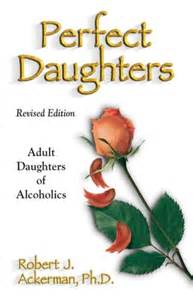
th-1My therapist recommended Perfect Daughters, by Robert Ackerman.  It reveals the struggles, characteristics, and patterns associated with adult daughters of alcoholics.  I learned that women of alcoholic fathers will often enter into relationships where they see an opportunity to heal the original father/daughter rift, and that this attempt is seldom successful.

What I have gleaned from experience is that I often tolerate behaviours for a long time, and that instead of seeing fault in the other, I will be quick to blame myself.  I know that I do not like confrontation, and that I feel like my complaints are trivial in the light of the bigger picture.  I have also learned that I often project unresolved feelings about my father into my current relationships, and  I recognized immediately that the gush of emotion over Ric’s innocent gesture was just that.

Many feelings related to childhood have bubbled up as a result of the stress of the past years.  I have been feeling the despair of never seeing an end to the hurt.  Ric, tired of his predicament became more defiant, pushing his limits, and striving to regain control over his life.  My response was accelerated anxiety and as much as I understand that he is an adult and makes his own choices, I find it hard not to react, spiraling into a dysfunctional dance of feeling like a child again, caught in a cycle of chaotic impossibilities, destined to be crushed.

Then I had a dream.  I don’t remember what it was, but I awoke with sudden understanding.  The panic I had been feeling is a product of my child’s need to finally feel in control.  Somehow, she believes that if she could just control my father /Ric’s behavior, then everything will be okay.  Her desire to control stems from a need to know that there is consistency in life, and that the process can be trusted.  She needs to feel secure and know that she is loved no matter what, not only if she behaves herself, or manages not to upset anyone.

The adult me knows that none of this is possible.  People will always behave and make choices outside of our control.  It is not a reflection of their love for us, but a product of their own inner workings.  Ric’s struggles and his attempts to resolve them are not about me, in reaction to me, or more importantly, because of me.  If his actions have consequences that affect me, then it is up to me to look after myself and make sure I have taken appropriate protective measures.

I am reminded of something one of my university profs once said.  It went something like this:  Where there is power over, love cannot exist.  Where there is power for all, love exists.   My father behaved as if he was the only one with power in the family.  I did not feel loved.  My marriage to Ric is a partnership and a sharing of power.  I feel his love for me.


Criticism Be Gone!

I was forty before I could finally ask my mother about her constant criticism of me growing up.   We were alone together, in the car, driving out of town.  I had her undivided attention.

th-4“Help me to understand, something,” I prefaced the conversation.  “When I was young, you always told me no one would ever love me.  What was that about?”

“I didn’t say it to be mean,”  she explained and I believed her.  My mother was not typically a malicious person.  “It’s just that you were so different from your sisters, and I was afraid for you.  I thought I was helping you by preparing you for the inevitable.”

“But why, Mom?  What was it about me that you thought was unloveable?”

“You were just so smart, and independent minded……”  she trailed off.  “I guess I thought that men don’t like smart women.”

“Do you understand that I heard what you said to mean that I was impossible to love?”

“Oh my God, that is not what I intended at all!  Of course you are loveable.  You are compassionate and kind, and you deserve to be loved.  I thought I was preparing you, that’s all.  You were just so different,  and I thought I had to protect you.  I never meant for you to think you weren’t loveable.”

She paused in reflection.

“When the school came to us and told us they had done some testing and wanted to send you to a special school for the gifted, I was scared.  I didn’t know how to handle it.  Your father was all for it, but all I could think about was how would you fit in, and who would ever love you.  I guess I thought I was helping.  You were an enigma to me.”

Mother’s criticism of me was born out of fear and ignorance;  my acceptance of her harsh words was a reflection of my need for her approval. 

I understood.  Within the context of my mother’s upbringing and beliefs, I did not fit the mold.  She was merely expressing fear related to her own limitations.  Unfortunately, for the first forty years of my life, I lived out my mother’s legacy, choosing partners who were incapable of loving me.

My mother was not the only one to be critical of my intellectual abilities.  “Everyone hated you,”  a drunken cousin once confessed to me, then added, “but I don’t know why – you’re so nice.”  Classmates called me Browner, implying that I only got good grades because I ‘kissed up’ to the teachers.   Even close friends have commented that I’m not really that smart.

By listening to the criticism, I began to devalue myself.  Driven by a need to be accepted, I started to act dumb.  Better to deny self than to be criticized, right?

Wrong!

Embracing criticism and taking it to heart is ultimately a sin against the self.  We are each uniquely created, and destined, and it is only through accepting our differences, and nurturing them, that we can truly be fulfilled.

th-3Rejecting criticism is the first step to living authentically, and the only hope for living purposefully and to full potential.

Armed with this new understanding, I will stop apologizing for who I am.  I will let go of the need for praise from others, and recognize that their criticism is more about their process than mine, and let it be.  I will celebrate who I am by committing to my own process, and focusing on my goals and gifts.

I will finally start living.


Whale Dreaming

I dream: 

We are in an open row boat, crossing a river, when I see a dark shape in the water below.  “That looks like a whale” I say.  “But how can it be?”  Yet as I watch the figure pass and emerge from the water, my suspicions are confirmed:  it is a whale.  It breaks free of the water and appears like a cartoon of a whale hovering over the river. “We are on the St Lawrence” Ric offers, and I understand, but how did we get here? 

Back home, my cousin drops by.  “I have rented a cottage in PEI, and I’m looking for someone to join me,” she says.  “I’ll put the word out,” I respond before realizing that I could join her.  Why not?  “I was hoping for that,” she smiles.  We make our plans – whether to go by car or fly.  I am excited.  “You can see whales from the shore,” I exclaim. 

Well, whales are different from snakes, and hopefully, an improvement.  We have been whale-watching twice, and both times it has been incredible, and awe-inspiring.  Whales are gentle creatures, despite their size.  To be close to a whale is to marvel at the power and grace of Nature.

So why whales?

Dreams bring us symbols and metaphors that speak to what lies below our conscious, ego, selves.  For the past seven months, my husband has been battling cancer as well as trying to heal from two accidents, and now four surgeries.   Up until a few weeks ago, we have both attempted to keep up with the normal pace of life, but the pressure has broken me, and I have succumbed to the stress.  I am exhausted by the emotional and psychological strain, physically incapable of keeping up.

It is as if we are crossing a wide river in an open row boat – crossing a wide, unknown river, with little protection from the elements – yes, that is how it feels.  We keep going even though we feel inadequate and we aren’t quite sure we know where this is leading us.

It is as if a large creature lurks in the water below us.  That large creature could be cancer, loss of life, or healing and renewal.  We have no way of knowing right now.  In the dream, it looks like a whale, but it ends up being a cartoon caricature of a whale.  Does that mean that my imagination has got the better of me, or that what appears to be so overwhelming will, in the end, seem trivial?

It is as if I have an opportunity to travel to P.E.I. with my cousin.  The cousin in my dream was one I looked up to and admired.  She suffered ill health for much of her life, but maintained an attitude of quiet acceptance until her death at the age of 53.  To have the chance to spend some time with her would give me new perspective and understanding.  P.E.I is not a place I have ever visited, but have been interested in.  It exemplifies simplicity and rural peacefulness, although my brother says it is too commercial.  He thwarted my one attempt to visit P.E.I. by rerouting me to Grand Manan, an island in the Bay of Fundy.  I definitely watched whales off the coast of this tiny island, and they accompanied our ferry ride to and fro.  It was the highlight of my trip.

So how does this dream apply to my life right now?  In the dream, I seem to lack clarity, not picking up on the signals and opportunities.  I am not aware of where I am, and question what I see, and when opportunity does come my way, I am slow on the uptake.

I do feel confused, and lacking clarity right now.  I worry that I am not taking the right course of action, and that I might be missing out on important opportunities.  While my husband seems to know where we are, I do not have my bearings.

In the dream, I am hoping to see whales.  How is this a metaphor for my life?  I want to experience the numinous – I want to feel the presence of something larger than life, something so magnificent that it will make me stop in awe and believe again.

I need a sign or an omen that will waken me from this nightmare of survival and remind me once again, that while this is one ‘whale of a tale’ that we are living, it only a moment in the greater scheme of things.  I need to be reminded of the miracle of Nature.

I need to remove myself from the constant churning of fear and anxiety and retreat to a place where time stands still and simplicity is the norm.  I need to slow down and let my heart calm.

(Image:  sam1311415102.blogspot.com)