This is ME/CFS

I don’t know if it is because Ric is away and I am feeling the entirety of my dependency, or if it is because it has been a year and there has been no discernible improvement, but I am struggling at present to keep depression at bay.

This disease, which is presently being re-named as SEID (Systemic Exertion Intolerance Disorder) presents a series of challenges that are seldom understood by the general public (or many medical practitioners).  In layman’s terms, I would like to describe them here:th-4

1.  While the cause of the disease is still in question, there is a consensus that there is a viral component.  The immune system, some believe, has exhausted itself in the fight against the unknown invader.   Antiviral treatment is recommended, however; many, such as myself, have an intolerance of chemicals, so have to carefully monitor the effects of anything we ingest.  While I have always suffered from food allergies and intolerance, I have found lately that this has increased – resulting in immediate skin or food sores.

T-cells, or friendly killer cells, are also compromised by this disease, as discovered by Dr. Klimas of the Institute for Neuro Immune Medicine in Miami.  Dr. Klimas’ clinic is currently the only one testing for and treating this aspect of the disease (that I know of).  The cost for a Canadian to visit the clinic is $10,000.  Please understand that this is for a consult, and commencement of a treatment protocol, not a cure.

2.  Widespread inflammation affecting the brain, spinal cord, and muscles.
Mentally, this means that cognitive functioning is affected.  Executive functioning – the ability to plan, organize ideas, or deal with complex thoughts – has become difficult (relative to my state of exhaustion), as has working memory – the ability to carry an idea or concept from one application to another.  Numbers, for example, are impossible to keep straight.  I might see the number 215, but when I try to relay it to another it will come out 415.  I constantly mix up dates, appointment times, etc, to the extent that Thor has to keep my personal calendar.  Reading and absorbing what I’ve read takes repetitive attempts, and writing is challenged by the loss of words, or recognition of words.

Inflammation of the spinal cord means my nervous system does not function properly.  Outside stimulus, such as smells, sounds, or movement, can be overly taxing.  My startle reflex, like a newborn baby’s, is on overdrive.  Emotions, whether positive or negative, send me into a spin, creating a “wired affect” which disturbs sleep and my ability to rest.

My muscles have become not only weak, but unreliable.  In the early stages, before diagnosis, I have would have weird cramping, like Charlie Horse’s, in my legs and feet.  Now, the sensations range from tautness and extreme weakness to a deep, relentless pain.  I will often stumble or fall, and drop things.  I can no longer count on my body to support me, so I walk with a walker for short distances and take a wheelchair otherwise.

3.  Orthostatic Intolerance is another factor in this disease.  Basically, my body can tolerate standing upright, or sitting, for short intervals only.  This makes cooking, showering, or even sitting in the car challenging.  I take most of my meals in bed, where I can have my feet raised, and recline the seat when in the car.  (Driving is not an option for me right now.)  Meals need to be simple and instant, unless someone else is preparing them – and I must say my husband has been a gem!

th-34.  Exercise (society’s answer to everything) is not so easy for the CFS/ME/Fibromyalgia patient.  While some strength training is recommended, aerobic exercise can severely set back any progress.  Trial and error is the protocol here, with a technique called ‘pacing’.  Pacing involves sandwiching activity with rest, keeping in mind that there is a limited amount of energy available for activities throughout the day.  For example, on the days that I wash my hair (now only once per week), I know I will have little energy left for anything else.  My doctor suggests setting a timer so as not to overdo anything, an idea I have yet to implement.

5.  Lack of restorative sleep.  I tend to suffer from insomnia, although this is improving.  Originally I would manage 3-5 hours of broken sleep per night, but lately 5 hours seems to be the norm.  Still not enough to feel recharged.  (I am not even sure if that is possible at this stage.)  Compensating with meditation seems to help, the key being to have solid chunks of time without disruption.  (No TV, radio, computer, phone calls, etc).  This is easier than it sounds.

6.  Grief/ depression:  naturally with the loss of mobility and normal functioning there is going to be reactive depression.  I am generally a happy, content person, but that only goes so far in the face of this challenge.  Unable to work, socialize, travel, or even tend to normal household routines, it is difficult to “keep the faith”.  Prior to becoming ill, I was passionately engaged with my work and my family, belonging to clubs, taking workshops, and so on.  I felt as if my life was going somewhere, and it was exciting.  Dropping out of sight means an automatic loss of the things that once brought sustenance:  relationships, goals/ planning, and a sense of purpose.  (Where is the purpose in being bed-ridden everyday?)  Grieving is not easy because it calls for resignation and acceptance, and my soul is not complying.  I keep telling myself that this is a big inconvenience that will one day just go away and I can get back to living.   Wrong!
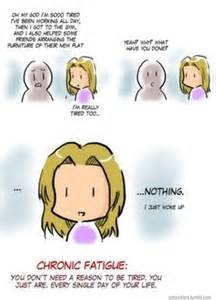
th-57.  Exhaustion.  This is not your weary at the end of a full work day exhaustion.  It is system wide.  Talk on the phone too long, hoarseness signals my vocal chords are tired.  Spend too much time on the computer (writing this has been an all day adventure), headaches set in, as well as mental fog.  Stand or sit for too long, I feel both my spine give out, as well as swelling in my lymph nodes.  Overall exertion – going out for dinner – and I am flattened for a period of time with flu-like symptoms.  The more I attempt to live a normal life, the more my system complains.  I would like to say that progress out numbers setbacks, however; the reverse it true.

When I told a nurse friend of mine that this disease is more prevalent than breast cancer, her response was “No way!  How can that be?” (meaning, how can it be that so little is known about it.)

I have a few thoughts on that matter.  Patients suffering with ME/CFS/ Fibromyalgia are often homebound, and therefore, out of sight.  They do not have the energy to walk for a cure or rally together for any awareness.   This is the invisible disability.

As there does not seem to be one drug treatment that addresses the issues, there is no money to support research (much research is funded by the pharmaceutical companies).  In fact, I think this disease is like the proverbial canary in the coal mine – a warning about how toxic our environment and food has become.  Who wants to face that?

So, where is the hope?  How do I cope and carry on?  I follow a very simple regime of diet and treatments:

a.  I avoid dairy and gluten in my diet, and wherever possible, processed foods.  I did follow a vegetarian diet for four years prior to being diagnosed, but have had to add some meat back into my diet for convenience matters, however; digestion of heavy meats causes severe IBS symptoms.  I have minimized caffeine intake, avoid alcohol, and need to work on eliminating sugar.

b.  I see a Doctor of Chinese Medicine for acupuncture and herbal supplements.  These include a probiotic, an adrenal boost, digestive enzymes, and other supports as needed.

c.  I see a specialist to address my allergies and asthma, as this is exacerbated by the disease.  I do take prescribed medications, which is constantly monitored.

d.  Restorative yoga is a recent addition to my treatment schedule.  A private instructor comes to the house and works with me on the bed.  I can incorporate this into my twice daily meditation/ rest time.  The instructor also gives me homework to improve my breathing and muscle strength.

e. I see a  psychologist regularly to ensure that I have support for depression, grief, and any other issues that might arise.  (It is amazing how much stuff comes up when you have nothing to do but lay around.)

f.  Pacing.  As mentioned before, this is the number one recommended approach to maintaining balance.  Limiting activities and stimulation is essential for staying out of the crash and burn cycle.

Sloane&Meg.  Social time is a very important part of keeping positive.  I have a few friends, as well as children, who visit regularly and are willing to lie beside me on the bed if need be.  My granddaughters are the best as they love to cuddle with Grandma.

h.  Writing is also an important part of my recovery.  To be able to remain passionate about something is a gift, and with today’s technology, even when my hands and wrists tire, I can dictate!

i.  Music and books on tape are the other stables in my regime.  Since my mind doesn’t allow me to concentrate enough for reading, I have found that listening to someone else read is a happy compromise.  Podcasts are even better, as they are often short and interesting.  Songza provides many playlists of mellow music for relaxing or meditation/yoga.  (Note: watching TV is not a good past time, as the combination of sound, visuals, and annoying commercials is overly stimulating.  If I do watch, I try to pre-record.)

j.  Games and apps.  Games that stimulate the brain are good in short intervals.  Magic Puzzles provides endless jigsaw puzzles that can be set at easy, medium, or more challenging.  ME/CFS Diary is an app that allows the patient to monitor patterns – this is excellent for tracking activities and symptoms to share with the doctor.  (I find it easier than filling out the daily paper logs).

k.  I have recently started taking short walks every day (five or six houses down the street).  The challenge with this (and any exercise) is making sure that I do just enough to make a difference without setting myself back.  This is still in the trial and error stage.

I hope this discussion of ME/CFS has been helpful.  I welcome comments and further discussion, and would like to reiterate that I am speaking purely as a layperson, and not as a medical expert.

The Same, But Broken

It is the state of fragility that blindsides me.
I am a strong woman.
Someone once told me I was courageous, but I cannot see it –
I have not chosen pain, grief,
illness.

The fragility is pervasive –
My body feels reduced to miniscule fibers:
stretched and torn, on the brink of brokenness.
Mind, overwhelmed, obsesses, but will not organize
or let go.
if only I could let go.
If you could see me I am weeping and not –
weeping from the frustration of the immediate impossibility
and unwilling to weep for the total loss.
It is beyond me.

Outside these walls life continues
and regards me with disgust/ indifference/ repulsion.
There is no equality for the ill and disabled.

And, yet….

In this state of rawness, stripped of “life”,
or rather, busy-ness,
I am as any other –

Just a soul trying to having a meaningful existence.

Maybe illness is the great equalizer.

(Image: background-pictures.picphotos.net)


Life Currently on Pause

Yesterday, I decided to pretend that the disease I suffer is not present.  Just for one night I wanted to take a break, be normal, live life. I am not talking big risks here people!  I am just talking a night of t.v. watching like in the old days, before I got sick.

“I’m still lying down, right?”  I convinced myself, hunkering in under the sheets.  “What can it hurt?”  That was 7:00 p.m.  At 11:00, I turned off the noise and distraction and retreated into sleep.

3:00 am the first repercussion hit me – constricted airways, choking for breath.  I staggered to the bathroom and my inhaler, then tried to go back to sleep.

No deal.  My overstimulated brain was locked on wired – replaying the details of the shows I’d watched over and over, like an ongoing, unsolvable debate.

I got up and made myself tea, and noticing a pronounced weakness, allowed my walker to support me.  I had overdone it.

I eventually fell back to sleep just after dawn, and now just coming up to noon, I have managed to get myself dressed.

Why is it so hard for me to learn this lesson?  My body/ mind/ emotions/ spirit have, through the vessel of this disorder (ME/CFS), sent me a clear and profound message:

P..A..U..S..E..!

So life, forgive me for opting out of participation right now – I am taking a sabbatical.

Sufficiency

My living room has beautiful big picture windows facing two directions, allotting me a full view of the neighbour’s front gardens to the north, and the constant comings and goings  on the  street in front of the house.  Lying on the couch with my morning cup of tea is how I like to greet the day.

On Sunday mornings, the rush of traffic is replaced by clusters of runners, with their long, sleek bodies, puffed out reddened faces, and self-satisfied grimaces.

“My wife had CFS,”  a man once told me, “but now she runs marathons.”

It is hard for me to believe.  The distance between my own physical capabilities and these weekend athletes far exceeds any race they might run, the copper-coloured legs of my sidekick walker remind me.

Maybe wheelchair races, I chuckle to myself.

Now that my life is confined to the four tiny rooms on the main floor of our home, I have new perspective.

I cannot remember a time when I did not feel lacking in my life – not enough hours in the day, not enough help, not enough money – but the truth is, in retrospect, I always had exactly what I needed.

Today, I do not have the legs to carry me swiftly on my way, nor do I have the energy to aspire to such feats, but I do have a home that I can easily navigate, surrounded by the endless beauty of Nature, and friends and family that truly care.

Abundance, I am discovering, is an attitude, not a state of material wealth.  It comes with the recognition that life is sufficiency, not lack.


Kindness Not Advice Needed For Ill

What is it about illness that invites so much input from others?  Everyone has an opinion and seem somehow emboldened by my vulnerability to express it, as if they have suddenly become the expert on all things health-related.

Since my diagnosis, I have been counselled to exercise more, eat more meat, eat no  meat, get magnetic therapy, see a psychic,  see a shrink (as it is surely all in my mind), and seek a second opinion.  All offered with the best of intentions, I am sure.

One friend even called from her therapist’s office and said she was on her way to get me, as he was positive he could help me.  “He says that what you’re doing is not enough,”  she told me excitedly.  “He has worked miracles with me.”

I have no doubt that he has helped her, and I bite back my desire to tell her that both he and she are being unbelievably arrogant as they have no idea what my course of treatment is at the moment, nor any idea what I have gone through to get to this point.

Diagnosis of ME/CFS does not happen haphazardly.  It comes after a series of specialists appointments, eliminating other diseases, and adding up to this particular one.  In my case, it has been four years of doctors, and testing, and worsening conditions that have led me to this point.  In the meantime, I have also been working with therapists and experts to find healthy solutions – specific to my ailments!

What I want to tell others is that while I appreciate their concern, the discussions drain me, and while their friendship is treasured, I have to limit my interactions, so would prefer to not keep going over this sensitive subject.   Trust me that healing is my number one priority, and that I am making healthy choices for myself.

Take a page from my friend, Naomi, who arrived for a visit last Monday.

“I can only stay for a quick visit,”  she announced, then steered the conversation to a discussion about our mutual interest – grandchildren.  After a precise amount of time, she said she had to go, and added:

“I know you are doing everything you can to get better, and I know you will be successful.”

Uplifted by her visit and vote of confidence, I saw her to the door, then headed for the fridge to find something for lunch.  Imagine my surprise and delight to find a fridge full of fresh fruit, and a ready prepared dinner, plus a few other special treats.

In her unassuming way, Naomi brought me great comfort that day.   Her actions, not just her words, spoke volumes in support of my healing.


ME/CFS: Just Need Clarity

The desire to re-engage with life is so potent that when any window of wellness pops up I grasp it and, like a naughty school child, ignore all well-intended warnings of caution.  It happened yesterday.  After two weeks of slumping, I felt almost normal.

“Aha!” I said to myself.  “I have energy!”  Before sensibility could get a hold of me, I bundled up the laundry that had been amassing unsorted in the bottom of the closet, and whisked it all downstairs into the laundry room, where more piles awaited.  (I know, this is preposterously bad behaviour, but believe me, laundry has that power over me.)

The plan – hastily devised – was to wait out the washing cycles downstairs.  Armed with an iPad, I thought the lazyboy would be a perfect place to set myself up in between loads.  “Seven minutes”, I told myself as I folded the stuff in the dryer, then:  “Maybe I should have done this sitting down.”  I chose to be optimistic.  “Oh well, I am feeling better today, I can afford a bit more time standing.”

The truth about this disease (ME/CFS) is that while the mind and intentions may play tricks, the body is absolutely clear about its limitations.  The tremors began as I stood folding.  I ignored them.

With a new load underway, I collapsed on the lazyboy and scooped up my iPad.  “Distraction is what I need!”  I tried to convince myself, turning it on.

The headache started next.  “Must be the lights.  I’ll turn them off next time I’m up.”

By the time the laundry was ready to turn over, my body was very clear:  Enough already!  I am shutting down.

“But I haven’t had this much energy in weeks; just let me do a little more,” I begged, while continuing to shuffle the loads.  I returned to the lazyboy, lights now off, and thought I’d try a bit of television – nothing too heavy.

I watched with my hand over my head, trying to hold back the pain.  I waited till the laundry finished.

“What are you doing?”  Ric caught me red-handed.  “I can do this!”

“I’m alright,” I lied.  “Just finishing up.  That’s it for the day.”

He grabbed the basket out of my hands and carried it up the stairs, clearly not believing me.

Truth is, I was not okay.  I had over-extended myself.  Again.

Why is it so hard, when my body speaks with such clarity, to honour its messages?

“Why do you have to make this so difficult for yourself?” Ric asked echoing my thoughts.

“I just want to feel like I’ve contributed something; like I am useful.”

That’s it really, isn’t it?  I used to know who I was, or I thought I did.  I had a sense of being a part of something greater than me; I had something to add.  Now, I am totally dependent on the kindness of others, with little to offer in return.

Who are we when all has been stripped away?  What are we left with that defines us beyond being the blob in the bed?  I guess this journey will, in time, reveal the answer.

This is the clarity I seek.

Adjusting to Life with ME/CFS

(Originally published October, 2014)

The news from the doctor was not so good today, or maybe it is that this news was no different from past visits, but my mind can only absorb the hard stuff in stages.

“I seem to be getting worse, not better.” I told her.

“That’s how it is often how it is with this disease,” she consoled. “Sometimes you have to hit bottom before you start climbing back up.”

I read my growing list of concerns: sleep remains a problem; eating is often accompanied by pain and abdominal swelling; I have painful swelling in my groin; breathing continues to be difficult; and my legs are unreliable.  Headaches, heart palpitations, sweating when upright, dizziness and flu-like symptoms.  I shake if I try to do anything standing, such as chopping vegetables.  I feel like I’m not getting anywhere.

She nods with each item, recording it in her files, and occasionally asking for clarification. “All typical symptoms,” she attempts to reassure me.  “Set a timer for standing:  try seven minutes.”

“Barely time to prep food,” I mutter.

“Buy food already prepared,”  she suggests.  “And make sure you are sitting with your feet up for meals.”

“Not the table?”  Eating at the table with my husband was the one bit of normalcy I was trying to hold onto.

“Do you have a lazy boy?  Try using it for meals.”  I do not have a lazy boy upstairs.  I will have to eat in bed.

“Set a timer for phone conversations and visits; they are also exhausting.”  I have noticed.

I have been tracking my daily activities, symptoms, and energy levels.  She scans my past four weeks:  nothing but chaos when I examine it.

“I see T.V. quite a bit.”  she shakes her head.  “T.V. is too draining.  Limit it to one hour per day.  Preferably commercial-free.  I’d rather see you writing than spending time on T.V.”

“It is a lot of noise,”  I agree.

In answer to my unasked question, she continues:

“Lying flat with your eyes closed is the best.  Listening to soft music is okay, and maybe books on tape if reading is difficult.  I also think it is time you consider using a walker.  Definitely a wheelchair when you go out anywhere.”

“Will I get better?”

“In a year you might see a return of energy, but not likely more than twenty-five per cent – hardly enough to consider working.  It takes time.”

The crushing in my chest when I leave is emotional.  You will have to grieve the life you have lost, I remember my therapist saying.  Today, I understand her warning.

Home again, I crawl into bed and try to breath through the heaviness that bears down on me.  Sobs release some of the oppressiveness, but I know it will linger for a while.

Healing is a shift in perspective, I always used to say.  Where is the new perspective here?

Well, I tell myself, Look at the bright side:  I won’t have to worry about wearing make up for a while, so my skin will get a break.  And I’ll have time to let my grey grow in without anyone noticing.  Think of the money I’ll save on clothes.

My twisted sense of humour always comes out at the worst of times.

If talking tires me, then maybe I’m going to learn to be a good listener.  That can’t hurt, right?

And wait!  Didn’t she say she would actually prefer it if I wrote instead of watching television!  You mean, maybe for the first time in my life, writing can become a routine and not an ocassional self-indulgence?  

Could it be that in the very moment I lose my legs, I gain wings?!

Ah, life!

Harmonics

6:30 a.m. alarm sounds.
“Time to wake up!” conditioned Compliance commands.
“Just a little longer,” Sensibility suggests.
Guilt, like an incessantly annoying child
tugs on Conscience:
“Come on, there’s lots to do!”
Body does not respond.

Sleep wins
and dreams come:
homeless,
relying on friends,
no food,
backed up toilet,
children’s wide eyes fearfully imploring
When is this all going to end?

Guilt propels a return to consciousness.

8:25 a.m.
“Up and at ’em! There’s a good soldier!” Compliance attempts to be chipper.
“There’s really nothing more important than rest,” Sensibility suggests.
“Can’t lie in bed all day!” Guilt counters.
But body is MIA.

Dreams surface again:
Setting up house in a thoroughfare,
people coming and going, oblivious to intrusion,
co-workers indifferent,
eyes scolding; convicting.

Guilt mutates to rage,
Body wakes up with a choking cough, and gasping,
reaches for the rescue inhaler
and sucks in, desperate for air.

11:11 am.
“That’s it! Up you get!”
“No! No! Rest is needed!”
“The day is wasted! There’s no getting it back!’

“SILENCE!” A new voice emerges.

A collective intake of breath.

“Breathe,” comes the message. “Just breathe.”

A unified sigh.

“And breathe again.”

Tempers cool, and emotions begin to settle.

“What’s going on?” Guilt wonders.
“Just trying to stick to routine,” Compliance explains.
“It’s always been this way.”
“But she’s ill now,” Sensibility adds, “and there needs to be concessions.”

“Breathe,” the voice reasserts, and all sigh again.
“Just be in the stillness of the moment.”

Stillness has no voice.
Its language is compassion and infinite,
infinite wisdom.

“And surrender.”

Compliance sobs with the release of such enormous obligation.
Sensibility gratefully gives over the burden of responsibility,
and Guilt…..well Guilt is little,
and happily snuggles up to Unconditional Love.

“There, there,” Voice soothes, “isn’t harmony so much better?”

Body concurs and rises out of bed.

As a Tree

Confined for hours at a time to my bed, I cheer myself by contemplating the trees outside my windows. There is something in their stoic beauty that both calms and inspires me.

Be as the tree a former meditation instructor taught me.

If I were a tree
my roots would run deep into the earth
and spread in all directions
grounding me.

Present.

My trunk would be wide and solid
weathering all storms
supporting other life
a tower.

Strong.

My branches would reach up to the sky
and dance with the breezes
and bend with the changing seasons
and bow to Nature.

Flexible.

If I were a tree
I would be calm, yet strong;
have heightened awareness, yet be rooted in reality.

I would yield to change,
yet stand proud in my own existence,
growing with grace.

If I were a tree
I would live in harmony
with Nature.

Present, Strong. Flexible.

Fully alive.

(Image from: www.nbcdfw.com)

On Suffering

“All I need is to win the lottery,” Mae often proclaims.

“That’s not true,” I tell her.

“But if I had enough money, my problems would all be solved.”

“No.  If you had lots of money, you would still be schizophrenic.”

She takes this in and nods solemnly.  Then she laughs.  “You’re so funny.”

“I am studying the dictionary, though.  If I can get smarter then I’ll be better, don’t you think so?”  (Mae finished nursing school with 96%).

“Schizophrenia has nothing to do with intelligence, it’s a chemical imbalance.  You are smart already.”

The conversation is redundant.  We will revisit it many times.

Mae, like many people, just wants an end to her suffering.

As a student of alternative health care techniques, and a caregiver, I too have looked for answers to the riddle of why suffering exists in the world.  I have witnessed parents watching their infant die, and young children sitting at their dying mother’s bedside.  I have met those whose disease has debilitated them to a point of total dependency; and others whose lives have changed in an instant due to an accident or violence.  And I have met many, like Mae, who are born into suffering, with no hope for a cure.  Void of answers, I am only left with more questions.

What I have come away with, though, is a sense of awe for the spirit that drives each and everyone of these people.  In the midst of so much tragedy, I have encountered strength, willingness, compassion, and incredible resilience.

I don’t believe, as some do, that suffering is a choice; I believe it is inevitable.   And in some instances, I believe that suffering can open the doors for much discovery.