Power and Virtue

Politicians are a breed of characters that I fail to understand – they have to be willing, on one hand, to ward off nonstop critical attack, and on the other, to subject themselves to constant pandering for favour.  If they are not driven by ideals, or even if they are, they will undoubtedly fall prey to persuasion by one power or another.  I am cynical to say the least, and disillusioned by the process for many reasons which I won’t discuss here.  In fact, politics is not usually a topic about which I am inclined to write.

Until my husband received an envelope in the mail bearing this quotation in place of the return address:

“Violent jihadism is not just a danger somewhere else.  It seeks to harm us here in Canada…. through horrific acts.  It is an act of war, and our government’s new legislation fully understands that difference.”

– Prime Minister Stephen Harper
January 30, 2015

“What is this?”

“The Conservative Party is looking for funding.”  Thor shrugged dismissively.

“Did you read this?  This is blatant fear-mongering!”

He took the envelope from me and perused it.  “Yes, it is,”  he replied dismissively as if to say:  And you’re surprised how?

I am more than surprised; I am gobsmacked!  The government’s tactic for raising money is to send out a war-tinged message?  Forgive me, but I always thought I lived in a peace based society, not a shoot-first-ask-questions-later regime.  This approach to fundraising is recklessly irresponsible on many levels, and as I am writing this while my mind and emotions are reeling, I fear I will not do them all justice.

First of all, there are a number of issues that plague Canadians today which deserve government attention:  justice for the missing (Aboriginal) women, under-serviced and impoverished communities, human trafficking, unemployment, aging population, threats to education, and so on, and so on.  Terrorism is one among many problems that need addressing.

Secondly, as I alluded to earlier, when did we become a warring country?   Historically, we have proven ourselves to be worthy allies and participants in war when called for, but I was raised to believe that peaceful resolution and humanitarian involvement was the Canadian way.    Has this changed?  Is the government hoping to sway opinion and spur war?  What possible positive motive can underlie the delivery of such a message?  Is this creating precedent for a new influx of money into our military resources?

Terrorism is not a new problem, by any means, and certainly a threat, but I do not think it is an issue that has been thoroughly examined and responsibly considered.  We just do not understands its mechanics.  Evidently, it is the product of hate and fanatical obsessions, and if viewed from that perspective, is not just the property of jihadism – it lurks beneath every so-called civilization.  Just yesterday, a young man sat amongst a group of parishioners in communal worship before turning his weapons on them.  This was an act of terrorism.

My eldest sister always told me I was naive, and perhaps I am, but I thought that we as a society were smarter than tactics like these.  Receiving this letter has just furthered my disappointment with a system that is severely flawed.

So, what might the Conservatives have offered instead?  How about something that demonstrates virtue, instead of appealing to our dark sides?  What about a message that reminds us how great our country is, and how important it is for us to continue to pursue avenues that support and build on our valued legacy?  Appeal to my sense of pride and my interest might be peaked, but threaten my intelligence and I am only incensed.

Having just read this to Thor, who is no longer affiliated with the Party, he asked if I read the letter enclosed.  I had not.  As expected, it includes more of the same propaganda, and a “Pledge of Commitment” asking a signed personal agreement, along with the requested $200 to help the Conservatives win the war on terrorism (my words).

Rant over, my conclusion is very clear – the mission has been successful.  I am now very afraid – not of ISIS and their “real threat to Canada” (quoted from the Pledge of Commitment).  I cannot even think about them at the moment.  No, this newly blossomed terror is for a menace much closer to home – the CPC (The Conservative Party of Canada).  If I doubted them before, I really fear them now!

(Image: wondergressive.com)

This is ME/CFS

I don’t know if it is because Ric is away and I am feeling the entirety of my dependency, or if it is because it has been a year and there has been no discernible improvement, but I am struggling at present to keep depression at bay.

This disease, which is presently being re-named as SEID (Systemic Exertion Intolerance Disorder) presents a series of challenges that are seldom understood by the general public (or many medical practitioners).  In layman’s terms, I would like to describe them here:th-4

1.  While the cause of the disease is still in question, there is a consensus that there is a viral component.  The immune system, some believe, has exhausted itself in the fight against the unknown invader.   Antiviral treatment is recommended, however; many, such as myself, have an intolerance of chemicals, so have to carefully monitor the effects of anything we ingest.  While I have always suffered from food allergies and intolerance, I have found lately that this has increased – resulting in immediate skin or food sores.

T-cells, or friendly killer cells, are also compromised by this disease, as discovered by Dr. Klimas of the Institute for Neuro Immune Medicine in Miami.  Dr. Klimas’ clinic is currently the only one testing for and treating this aspect of the disease (that I know of).  The cost for a Canadian to visit the clinic is $10,000.  Please understand that this is for a consult, and commencement of a treatment protocol, not a cure.

2.  Widespread inflammation affecting the brain, spinal cord, and muscles.
Mentally, this means that cognitive functioning is affected.  Executive functioning – the ability to plan, organize ideas, or deal with complex thoughts – has become difficult (relative to my state of exhaustion), as has working memory – the ability to carry an idea or concept from one application to another.  Numbers, for example, are impossible to keep straight.  I might see the number 215, but when I try to relay it to another it will come out 415.  I constantly mix up dates, appointment times, etc, to the extent that Thor has to keep my personal calendar.  Reading and absorbing what I’ve read takes repetitive attempts, and writing is challenged by the loss of words, or recognition of words.

Inflammation of the spinal cord means my nervous system does not function properly.  Outside stimulus, such as smells, sounds, or movement, can be overly taxing.  My startle reflex, like a newborn baby’s, is on overdrive.  Emotions, whether positive or negative, send me into a spin, creating a “wired affect” which disturbs sleep and my ability to rest.

My muscles have become not only weak, but unreliable.  In the early stages, before diagnosis, I have would have weird cramping, like Charlie Horse’s, in my legs and feet.  Now, the sensations range from tautness and extreme weakness to a deep, relentless pain.  I will often stumble or fall, and drop things.  I can no longer count on my body to support me, so I walk with a walker for short distances and take a wheelchair otherwise.

3.  Orthostatic Intolerance is another factor in this disease.  Basically, my body can tolerate standing upright, or sitting, for short intervals only.  This makes cooking, showering, or even sitting in the car challenging.  I take most of my meals in bed, where I can have my feet raised, and recline the seat when in the car.  (Driving is not an option for me right now.)  Meals need to be simple and instant, unless someone else is preparing them – and I must say my husband has been a gem!

th-34.  Exercise (society’s answer to everything) is not so easy for the CFS/ME/Fibromyalgia patient.  While some strength training is recommended, aerobic exercise can severely set back any progress.  Trial and error is the protocol here, with a technique called ‘pacing’.  Pacing involves sandwiching activity with rest, keeping in mind that there is a limited amount of energy available for activities throughout the day.  For example, on the days that I wash my hair (now only once per week), I know I will have little energy left for anything else.  My doctor suggests setting a timer so as not to overdo anything, an idea I have yet to implement.

5.  Lack of restorative sleep.  I tend to suffer from insomnia, although this is improving.  Originally I would manage 3-5 hours of broken sleep per night, but lately 5 hours seems to be the norm.  Still not enough to feel recharged.  (I am not even sure if that is possible at this stage.)  Compensating with meditation seems to help, the key being to have solid chunks of time without disruption.  (No TV, radio, computer, phone calls, etc).  This is easier than it sounds.

6.  Grief/ depression:  naturally with the loss of mobility and normal functioning there is going to be reactive depression.  I am generally a happy, content person, but that only goes so far in the face of this challenge.  Unable to work, socialize, travel, or even tend to normal household routines, it is difficult to “keep the faith”.  Prior to becoming ill, I was passionately engaged with my work and my family, belonging to clubs, taking workshops, and so on.  I felt as if my life was going somewhere, and it was exciting.  Dropping out of sight means an automatic loss of the things that once brought sustenance:  relationships, goals/ planning, and a sense of purpose.  (Where is the purpose in being bed-ridden everyday?)  Grieving is not easy because it calls for resignation and acceptance, and my soul is not complying.  I keep telling myself that this is a big inconvenience that will one day just go away and I can get back to living.   Wrong!
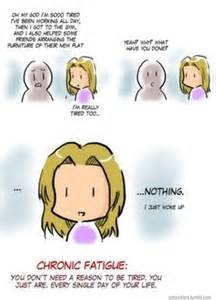
th-57.  Exhaustion.  This is not your weary at the end of a full work day exhaustion.  It is system wide.  Talk on the phone too long, hoarseness signals my vocal chords are tired.  Spend too much time on the computer (writing this has been an all day adventure), headaches set in, as well as mental fog.  Stand or sit for too long, I feel both my spine give out, as well as swelling in my lymph nodes.  Overall exertion – going out for dinner – and I am flattened for a period of time with flu-like symptoms.  The more I attempt to live a normal life, the more my system complains.  I would like to say that progress out numbers setbacks, however; the reverse it true.

When I told a nurse friend of mine that this disease is more prevalent than breast cancer, her response was “No way!  How can that be?” (meaning, how can it be that so little is known about it.)

I have a few thoughts on that matter.  Patients suffering with ME/CFS/ Fibromyalgia are often homebound, and therefore, out of sight.  They do not have the energy to walk for a cure or rally together for any awareness.   This is the invisible disability.

As there does not seem to be one drug treatment that addresses the issues, there is no money to support research (much research is funded by the pharmaceutical companies).  In fact, I think this disease is like the proverbial canary in the coal mine – a warning about how toxic our environment and food has become.  Who wants to face that?

So, where is the hope?  How do I cope and carry on?  I follow a very simple regime of diet and treatments:

a.  I avoid dairy and gluten in my diet, and wherever possible, processed foods.  I did follow a vegetarian diet for four years prior to being diagnosed, but have had to add some meat back into my diet for convenience matters, however; digestion of heavy meats causes severe IBS symptoms.  I have minimized caffeine intake, avoid alcohol, and need to work on eliminating sugar.

b.  I see a Doctor of Chinese Medicine for acupuncture and herbal supplements.  These include a probiotic, an adrenal boost, digestive enzymes, and other supports as needed.

c.  I see a specialist to address my allergies and asthma, as this is exacerbated by the disease.  I do take prescribed medications, which is constantly monitored.

d.  Restorative yoga is a recent addition to my treatment schedule.  A private instructor comes to the house and works with me on the bed.  I can incorporate this into my twice daily meditation/ rest time.  The instructor also gives me homework to improve my breathing and muscle strength.

e. I see a  psychologist regularly to ensure that I have support for depression, grief, and any other issues that might arise.  (It is amazing how much stuff comes up when you have nothing to do but lay around.)

f.  Pacing.  As mentioned before, this is the number one recommended approach to maintaining balance.  Limiting activities and stimulation is essential for staying out of the crash and burn cycle.

Sloane&Meg.  Social time is a very important part of keeping positive.  I have a few friends, as well as children, who visit regularly and are willing to lie beside me on the bed if need be.  My granddaughters are the best as they love to cuddle with Grandma.

h.  Writing is also an important part of my recovery.  To be able to remain passionate about something is a gift, and with today’s technology, even when my hands and wrists tire, I can dictate!

i.  Music and books on tape are the other stables in my regime.  Since my mind doesn’t allow me to concentrate enough for reading, I have found that listening to someone else read is a happy compromise.  Podcasts are even better, as they are often short and interesting.  Songza provides many playlists of mellow music for relaxing or meditation/yoga.  (Note: watching TV is not a good past time, as the combination of sound, visuals, and annoying commercials is overly stimulating.  If I do watch, I try to pre-record.)

j.  Games and apps.  Games that stimulate the brain are good in short intervals.  Magic Puzzles provides endless jigsaw puzzles that can be set at easy, medium, or more challenging.  ME/CFS Diary is an app that allows the patient to monitor patterns – this is excellent for tracking activities and symptoms to share with the doctor.  (I find it easier than filling out the daily paper logs).

k.  I have recently started taking short walks every day (five or six houses down the street).  The challenge with this (and any exercise) is making sure that I do just enough to make a difference without setting myself back.  This is still in the trial and error stage.

I hope this discussion of ME/CFS has been helpful.  I welcome comments and further discussion, and would like to reiterate that I am speaking purely as a layperson, and not as a medical expert.

A Case for Moderation

“Before illness,”  I tell my therapist, “I had things I was working on – I was engaged with life.  Now I can’t do any of that.  I feel useless.”

She nods.  “Yes, that is what illness does.”

I’d had two days of feeling better.  Two days of being able to sit up and actually do a bit of housework.  “I felt so good that I actually started to allow myself to make plans,”  I tell her, choking up.

“That is the trouble with this disease,”  she explains.  “Patients have good days, and they do things, and it sets them back.  You need to learn to enjoy the days you are feeling better, without increasing your activity.  Your body needs rest; rest is what is going to get you well again.”

I look away.  How can I tell her about the messages that have been haunting me these past days?

“I feel stripped of all purpose,”  I manage to confess.

“Ah,” she says knowingly.  “One of the things that we are able to do when we are well is avoid the voices in our head; without all that busyness we are alone with our demons.”

“Exactly!”  I love this woman!  “It sounds crazy, but I keep hearing my father’s voice.”

“What is he saying?”  She leans forward.

You don’t have any problems!  You don’t even know what problems are! ”  There were more too:  Time is money.  Waste not, want not.    I tell her about how he never allowed us to sleep in, made us get up and do drills on Saturday morning before cleaning the house.

th-1.jpeg“Your father wanted you to be strong, able to face whatever life threw at you.  What is missing from that picture is the message that home is the soft place to land.”

Her words strike a chord.  “That concept was foreign to me for most of my life,” I tell her.  “I never even conceived of it until I met Ric.  Isn’t that awful?”

She gives me a sad smile.  “The trouble with growing up in a family where work ethic is everything is that you are always living up to someone else’s expectations.  Your father set the bar high and to get there, you had negate all natural instincts.  You weren’t allowed to feel tired, sad, angry, etc.  All that would be pushed aside in order not to disappoint him.”

Even as she speaks, I see myself going to my room, disheartened by my feelings, wanting to hide – out of sorts.  Emotions were not welcome in our house; weakness was abhorred.

“Then you found yourself alone as a single mom with three kids.  There was no time for your needs.  No time to be sick, or rest, so you carried on out of necessity.”

“And I had my own business,”  I add to the list in my head.  “No possibility of taking time off there.”   To my therapist, I add:  “I don’t know how to banish the guilt.”

“Journal the messages when they pop up,”  she suggests.  “That way you can get them out of your head and onto paper where you can see how useless they are.  Tell yourself that by resting you are doing exactly what you need to be doing.  Getting better is all about listening to your body.”

“And when others ask me what I’ve done with my day…….?”

“Their questions are triggering you childhood demons.  You are hearing your father’s voice behind them.  Tell them you are doing exactly what you need to be doing to get well.  Leave it at that.”

I sigh.  For months now, I have felt like I have to justify my existence to everyone.  I have felt like such a failure.

“I have done the same thing to my children,”  I blurt out.

“Likely,”  she smiles.  “It’s all you’ve known.”

“Oh God,”  I moan.

“There is nothing wrong with a good work ethic as long as it’s balanced with proper rest.  It’s all about moderation.”

I have missed the moderation piece of life’s puzzle.

Will I ever learn?


Sufficiency

My living room has beautiful big picture windows facing two directions, allotting me a full view of the neighbour’s front gardens to the north, and the constant comings and goings  on the  street in front of the house.  Lying on the couch with my morning cup of tea is how I like to greet the day.

On Sunday mornings, the rush of traffic is replaced by clusters of runners, with their long, sleek bodies, puffed out reddened faces, and self-satisfied grimaces.

“My wife had CFS,”  a man once told me, “but now she runs marathons.”

It is hard for me to believe.  The distance between my own physical capabilities and these weekend athletes far exceeds any race they might run, the copper-coloured legs of my sidekick walker remind me.

Maybe wheelchair races, I chuckle to myself.

Now that my life is confined to the four tiny rooms on the main floor of our home, I have new perspective.

I cannot remember a time when I did not feel lacking in my life – not enough hours in the day, not enough help, not enough money – but the truth is, in retrospect, I always had exactly what I needed.

Today, I do not have the legs to carry me swiftly on my way, nor do I have the energy to aspire to such feats, but I do have a home that I can easily navigate, surrounded by the endless beauty of Nature, and friends and family that truly care.

Abundance, I am discovering, is an attitude, not a state of material wealth.  It comes with the recognition that life is sufficiency, not lack.


Kindness Not Advice Needed For Ill

What is it about illness that invites so much input from others?  Everyone has an opinion and seem somehow emboldened by my vulnerability to express it, as if they have suddenly become the expert on all things health-related.

Since my diagnosis, I have been counselled to exercise more, eat more meat, eat no  meat, get magnetic therapy, see a psychic,  see a shrink (as it is surely all in my mind), and seek a second opinion.  All offered with the best of intentions, I am sure.

One friend even called from her therapist’s office and said she was on her way to get me, as he was positive he could help me.  “He says that what you’re doing is not enough,”  she told me excitedly.  “He has worked miracles with me.”

I have no doubt that he has helped her, and I bite back my desire to tell her that both he and she are being unbelievably arrogant as they have no idea what my course of treatment is at the moment, nor any idea what I have gone through to get to this point.

Diagnosis of ME/CFS does not happen haphazardly.  It comes after a series of specialists appointments, eliminating other diseases, and adding up to this particular one.  In my case, it has been four years of doctors, and testing, and worsening conditions that have led me to this point.  In the meantime, I have also been working with therapists and experts to find healthy solutions – specific to my ailments!

What I want to tell others is that while I appreciate their concern, the discussions drain me, and while their friendship is treasured, I have to limit my interactions, so would prefer to not keep going over this sensitive subject.   Trust me that healing is my number one priority, and that I am making healthy choices for myself.

Take a page from my friend, Naomi, who arrived for a visit last Monday.

“I can only stay for a quick visit,”  she announced, then steered the conversation to a discussion about our mutual interest – grandchildren.  After a precise amount of time, she said she had to go, and added:

“I know you are doing everything you can to get better, and I know you will be successful.”

Uplifted by her visit and vote of confidence, I saw her to the door, then headed for the fridge to find something for lunch.  Imagine my surprise and delight to find a fridge full of fresh fruit, and a ready prepared dinner, plus a few other special treats.

In her unassuming way, Naomi brought me great comfort that day.   Her actions, not just her words, spoke volumes in support of my healing.


Adjusting to Life with ME/CFS

(Originally published October, 2014)

The news from the doctor was not so good today, or maybe it is that this news was no different from past visits, but my mind can only absorb the hard stuff in stages.

“I seem to be getting worse, not better.” I told her.

“That’s how it is often how it is with this disease,” she consoled. “Sometimes you have to hit bottom before you start climbing back up.”

I read my growing list of concerns: sleep remains a problem; eating is often accompanied by pain and abdominal swelling; I have painful swelling in my groin; breathing continues to be difficult; and my legs are unreliable.  Headaches, heart palpitations, sweating when upright, dizziness and flu-like symptoms.  I shake if I try to do anything standing, such as chopping vegetables.  I feel like I’m not getting anywhere.

She nods with each item, recording it in her files, and occasionally asking for clarification. “All typical symptoms,” she attempts to reassure me.  “Set a timer for standing:  try seven minutes.”

“Barely time to prep food,” I mutter.

“Buy food already prepared,”  she suggests.  “And make sure you are sitting with your feet up for meals.”

“Not the table?”  Eating at the table with my husband was the one bit of normalcy I was trying to hold onto.

“Do you have a lazy boy?  Try using it for meals.”  I do not have a lazy boy upstairs.  I will have to eat in bed.

“Set a timer for phone conversations and visits; they are also exhausting.”  I have noticed.

I have been tracking my daily activities, symptoms, and energy levels.  She scans my past four weeks:  nothing but chaos when I examine it.

“I see T.V. quite a bit.”  she shakes her head.  “T.V. is too draining.  Limit it to one hour per day.  Preferably commercial-free.  I’d rather see you writing than spending time on T.V.”

“It is a lot of noise,”  I agree.

In answer to my unasked question, she continues:

“Lying flat with your eyes closed is the best.  Listening to soft music is okay, and maybe books on tape if reading is difficult.  I also think it is time you consider using a walker.  Definitely a wheelchair when you go out anywhere.”

“Will I get better?”

“In a year you might see a return of energy, but not likely more than twenty-five per cent – hardly enough to consider working.  It takes time.”

The crushing in my chest when I leave is emotional.  You will have to grieve the life you have lost, I remember my therapist saying.  Today, I understand her warning.

Home again, I crawl into bed and try to breath through the heaviness that bears down on me.  Sobs release some of the oppressiveness, but I know it will linger for a while.

Healing is a shift in perspective, I always used to say.  Where is the new perspective here?

Well, I tell myself, Look at the bright side:  I won’t have to worry about wearing make up for a while, so my skin will get a break.  And I’ll have time to let my grey grow in without anyone noticing.  Think of the money I’ll save on clothes.

My twisted sense of humour always comes out at the worst of times.

If talking tires me, then maybe I’m going to learn to be a good listener.  That can’t hurt, right?

And wait!  Didn’t she say she would actually prefer it if I wrote instead of watching television!  You mean, maybe for the first time in my life, writing can become a routine and not an ocassional self-indulgence?  

Could it be that in the very moment I lose my legs, I gain wings?!

Ah, life!

Nature’s Divinity

Well before I was of an age to articulate it, I understood that there was something sacred about nature. An indescribable presence spoke to me and I, unscathed by the creeds of modern religion, learned to listen with reverence.

My appreciation for a Higher Being was stirred in the gardens of my birthplace. The vibrant colours of the many species of flowers and the busy, other world, of the insects that inhabited these gardens spoke to me of a whole world that was invisible to the ordinary eye. Life within life. I was captivated.

By the age of five, I began to wander beyond the garden gate, across the tilled fields of the farm that our home bordered, and into the woods beyond. There my true schooling began.

The woods were untamed – a tangle of old and new growth, thickly blocking any paths – and if I was careful enough to pick my way through, I came to a natural opening where a creek ran through. The water, like my soul, was clear and revealed every little secret.

For hours, I would squat and behold its wonders: tadpoles in the springtime, crayfish burrowing in the sand, and even the twigs that would be carried by the current, get stuck in the rocks and resist the flow of water until they were released again.

I discerned a certain pattern to the life I was witnessing: a sense of harmony and purpose.

Lucky enough to live in a country with four seasons, I absorbed the lessons of change, and learned to read the signs. The shifting wind, for instance, spoke of brooding weather, or the coming of spring after the winter’s slumber. I learned that life has cycles, and that after every winter comes the rains and new hope of brighter days.

Another of my favourite spots was deep within the woods, where the light beams trickled through the leaves like a cascade of fairy sparkles. Burrowing into the soft soil of the earth, I would sit quietly, patiently, until nature revealed herself to me. The woods, I discovered, much like the garden of my own backyard, housed a thriving population: insects, birds, animals, and reptiles – all whose existence seemed to rely on one another.

I wanted more than to be a part of it all – accepted, belonging: a child of Nature.

And then I lost my innocence.

I attended church, and learned that God lived in a church, and that I was not worthy of His love, and therefore; I needed to repent. I needed to repent because I was blemished by sin, and that felt dirty, and the earth that I so loved became undesirable, and bugs were icky, and nature was something wild to be feared.

I began to doubt my own understandings.

I learned to doubt me.

I lost confidence.

I no longer listened to the signs.

I learned to want for things, material things, anything, that would fill the void. Disconnected from the reverent, life felt out of control, something to be feared, not revered.

But nature has a way of reminding, even the most diehard non-believers, that there is more to life than we can see, and that a force, inexplicable, and sacred exists, and it came knocking on my windowpane tonight, with a message in the form of unseasonal gale winds and hail, and woke me from slumber.

And my soul answered, like the child I had once been, with a joyous recognition that despite all our theories, and doctrines, and delusions of educated knowledge, there still exists a life within a life: the Great Mystery that defies us and keeps us ever humble.


T

What I’ve Learned From Trees

Meditating on the majestic beauty of the trees outside my window, I come to recognize something about myself. I cannot help but think that even though they are symbols of quiet strength, trees are not without their own vulnerabilities. Acts of Nature, or even human folly can bring them down, and so they, like me, are not immortal.

th-3Perhaps none of us is meant to be an impenetrable force: the kind of force I aspired to in my youth.

You see, I always thought of myself as a strong woman, however; unlike the trees I contemplated in my last post, I was not flexible – bending graciously to the winds of change – but belligerent, resistant, and arrogant. I was a right fighter. Having grown up in an atmosphere of relentless uncertainty, I commanded myself to be strong, believing that with an iron will, I could gain control of life – not just my own, but the lives of those around me. I adopted an air of superiority – pretending to know better than anyone else – even though on the inside, I never measured up. Showing vulnerability was never an option. Instead, I must have appeared the fool, and undoubtedly hurt many others.

True strength, I realize now, comes in retreating in the face of adversity, and the willingness to see beyond personal righteousness. It involves an openness to understanding alternative perspectives, and the wisdom to perceive the truth underlying the turmoil.

th-4My current life circumstances have brought me limitations: physically and mentally. My awake and energetic times are severely restricted. I am challenged to create a new definition of self, and what it is to be strong.

I dreamt of my dear cousin Bev last night. Bev passed away recently after battling cancer for ten years. In all those years she faced her struggle with a quiet strength: maintaining her outer poise, surrendering to the times of severe illness, and establishing healthy boundaries. She was a model for gracious living. Truly a strong woman.

Illness has brought me an opportunity to retreat for a while. It is allowing me the possibility of real change: measurable change. In surrendering my old sense of self, I will surely emerge new.

In the meantime, I remain open and vulnerable – not comfortable – but then at fifty-six years of age, I am well rooted. Like the trees.

The Drive Behind the Quest

I was nine, when I first asked God to let me die: I’d had enough of life. By the time I was fifteen, I was pleading: “Really, God. I am happy with all the experiences I’ve had. You can bring me home now.”

Once I realized that my mortality (suicide aside) was not negotiable, and convinced that God had forsaken me, I was determined to control my own destiny. Intolerance and judgment became my life maps. I went into overdrive to “get there”, wherever “there” was. I worked long hours, partied hard, and grasped at opportunities. I forgot to pack an emergency kit, so when life broke down, I was not prepared.

One thing I did know: my life wasn’t working for me.

That is when my quest began. I hungered for a deeper sense of purpose and an inner peace. I wanted to feel bliss and live from gratitude.

I first encountered the Tao through Tai Chi. “Tao means ‘how'” the instructor told me. “It seeks to explain the Universe.”

“Yes!” I thought. “This is what I need.”

I embraced spirituality with a great hunger, consuming philosophies and teachings with unbridled enthusiasm. My mind thrilled to the challenge of cryptic codes believing that I could find meaning and order in everything, and everyone, I encountered. My compulsive need to fix thrived under the poorly masked guise of “love and light”. I really hadn’t changed; I’d just chosen a different vehicle to drive.th-3

Until it all blew up and those I felt closest to walked away.

I still quest, but now it is for simplicity and contentment. I am tired of complication and drama. I have seen too much. I am focusing now on letting go; and supporting others in their choices, allowing for the beauty of life’s natural order (and disorder) to unfold before me.

Truth is, whatever control we think we think we have is an illusion for the most part. Self-control, maybe, but never where others are concerned. For me, my mishmash spirituality helps me hang up that hat: my chauffeur’s cap. I am not driving anyone anywhere these days. Instead, I hope that others invite me along because I am me, and that me spreads love, acceptance and support.

As I learned long ago, some choices in life our not our own, but how we live is.
I still have a lot to learn. Guess I’ll be around for a while.

(Feature image:  thejesuschick.com)(Other: www.inquisitr.com)

Simplicity: A Noble Quest

At thirty-one, I had to learn to change my approach to life, because the old way wasn’t working.

th-2The old way put me at the center of the family (even though I was fifth born), listening to and attempting to resolve every family issue:   Do you think your younger sister is okay living out there in isolation?  Your older sisters are not talking to each other.  I can’t talk to Mom, will you?  Why do men always leave me?  Your brother thinks I abandoned him as a child.  I can’t talk to Dad; he’ll listen to you. Your brother is coming to stay, and well, you know about his wife.   I can’t live with your Father.  And on and on.

The old way was me constantly trying to run from my problems, striving to be better, to do better, and to get ahead.  I was invested in the belief that if I could just do the right thing, my life would be perfect.  I beat myself up trying to reach some magical destination where peace would prevail, and all would be well with the world.

Attachments, chaos, interference, and desires were destroying me.  I lived in a perpetual state of strife and discontentment.

And then the blessing came:  my mind snapped.

As I picked up the pieces of my life, I had to learn to simplify.

th-3I was gifted with new objectivity.  I realized that even though my own life had come to a screaming stop,  everyone else’s went on without me.  The chaos and drama of my family continued, and for the first time in my life, I recognized that I had no ability to control it.  Never had.  My need to feel important and responsible in the midst of that whirlwind was my own sick way of coping.  Nothing I said, did, or sweat over was going to change the outcomes.  I learned to detach and stop interfering.

Mom and Dad are trying to run my life.

“You are strong and have supports.  I trust that you can deal with this.”

Find out what’s wrong with your sister.

“I have my own relationship with my sister, and would prefer that you do the same.  Let’s not get them confused.”

It was the first step to learning to breathe again.

Losing my mind also put a stop to all that rushing around.  I was forced to stand still, which meant everything I had been running from caught up to me.  Egads!  I went into therapy.

th-4My family, I came to understand, dealt with dilemma’s by creating more distractions: new problems.  Our momentum came from the next crisis and there was never any shortage of those.  The problem with this way of living is that the underlying message is that there is something so wrong, so unmentionable, that it is not safe to relax, and so we hang on until the next cliff hanger.  The only control I had in all of this was to no longer choose to be part of it.  Peace, I discovered, was an inner journey and not an outer destination.  Boy, had I been on the wrong track!

“What is it that you really desire?”  the therapist asked me one day.

“I don’t know,” came the response, and it was true.  I had been driving myself so hard, I had forgotten what it was that I was aiming for in the first place.

Life, I concluded, is not a game in which the person with the best ideas, and the most responsibility wins.  It is a journey of moments, and discoveries, and connections, which if we’re not careful, we will miss.  Simplicity, my heart’s actual desire, is being able to minimize the attachments, resist the need to interfere, and be the calm at the center of the storm.

I’m still working on it, but at least now, I am more aware.