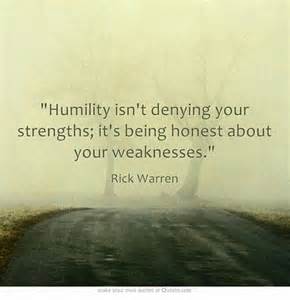
Humility

Good, better, best.   Never let them rest.  Till your good is better and your better best.

Dad made us recite this whenever he thought that we were giving less than our best effort.  Like the time I came home with a 96% in OAC Relations and Functions.  If I could get 96, I could get a hundred; I just wasn’t trying hard enough.

The message I heard was that if wasn’t the best, I wasn’t good enough.  I told myself that there was no point in trying, but under it all, I just wanted his approval.  Of course, I couldn’t be the best, so I learned to act like I was better by putting others down.  As a young woman, I was constantly angry and intolerant of stupidity or lack of common sense.  I had no patience for weakness, and though I hate to admit it, I found fault with anyone who I thought was better than me.

Lucky for me, I learned the importance of humility.  Not all at once, but over a progression of events.

The idea of humility was first introduced to me by my Religious Studies teacher, in university.  He said the humble man was the happiest man, because he could just be and appreciate life.  I didn’t quite understand, but the idea intrigued me.

My second child added to the learning.  Baby number one was a calm and very manageable baby: a testimony, I thought, to my excellent parenting skills.  Other people clearly didn’t know how to parent, I told myself when I would see a screaming child.  Then Ester came along, and shattered that illusion, humbling me in the process.

Perhaps the greatest lesson came at the age of thirty-one, when my mind snapped.  A mother of three, I was working full-time to support the family, taking courses at the university to improve my qualifications, caring for my dying sister, and trying to find time to work out and diet so I would be more appealing to my husband.  I thought I could do it all.  I couldn’t it.  The walls of my carefully constructed existence came tumbling down, and I was lost in a black abyss of nothingness, unable to function.

It was the best thing that ever happened to me.

Clawing my way out of the pit of despair, I came upon this quote (author unknown):

I turned to God when my foundation was shaking, only to find that God was shaking my foundation.

“Get off your high horse, and come down to earth where you can be more useful!”  Not God’s words, but my interpretation.

Do you know what I discovered?  Letting go of having to be the best meant I could start to celebrate the successes of others rather than try to bring them down – a much more rewarding use of my energy.

Oh, and I let go of the fear of not being good enough.

In fact, I decided that I am good enough.

No, scratch that.  I am good.

Wait, even that is overstated.

I am!


An Unexpected Lesson

On April 15, 1978, I married for the first time.  It was also the day my eldest sister was diagnosed with leukemia and given one month to live – a year, if she had any fight in her.  I was nineteen.

As a young woman, I viewed life’s issues as black and white, and was often intolerant and impatient of others.  Now, thrown into a world of uncertainty, I was ill-equipped to cope.  Jo was a single mother of one, and asked for my help and support.  I vowed to be there for her, but had no idea what that would entail.

Even though we were siblings, my sister and I could not be further apart.  Eleven years my senior, Jo was born with a hole in her heart, a condition that saw her constantly in and out of hospital as a child.  At thirteen, on the brink of death, a new procedure, open-heart surgery, saved her life.  Much of our family’s energy and attention centered around Jo’s well-being, which was always a difficult task.  Coddled as a child, and setback by illness, Jo was temperamental, self-centered, and high-spirited.  If there was a fight to be had, she would instigate it.  She was reckless, impulsive, and emotionally immature.  At nineteen, she was unwed and pregnant.  She insisted on marrying the child’s father, but it didn’t last.  A string of bad relationships followed, along with several moves, in and out of our family home.  It seemed, Jo had a knack for creating chaos.

In contrast, although fifth born, I played the role of the responsible, sensible child, often trying to mediate calm in our tumultuous lives.   It was the natural order of things for Jo to turn to me for help.   I signed on as legal guardian of my niece, and accompanied my sister to medical appointments.  She underwent intense chemotherapy, and many times we thought we were losing her, but Jo would rally round again.

I learned from my sister, that life is often grey –  that uncertainty, and change are givens – and this rattled my sense of self-righteousness.  I felt inadequate and overwhelmed.  Pursuing education in the medical field was never an option for me, as a I was a fainter.  Instead, I sought understanding of the psychological and spiritual aspects of illness.  It would lead me to years of study and a career.

I don’t know how much I actually ever helped my sister.  She was never open to any of the ideas or approaches that I studied, and she never became any easier to get along with.  Her survival, fourteen years beyond the initial diagnosis, can only be attributed to an incredible fighting spirit and will to live.  She never changed.  I, however, was forever altered because of her.

I was with my sister the night she died, holding her hand as promised.   She was one of my greatest teachers.

(Image from Pinterest)