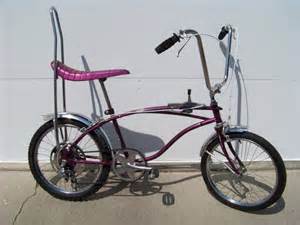
“Can I have a bike for my birthday this year?” A typical, impatient eight-year-old, I must have asked my parents this question a million times. I was excited for my upcoming birthday, and really wanted a bike with a big banana seat, and raised handle-bars.
“You’ll have to wait and see,” was the constant reply, but my birthday falls in the middle of the summer, and so many perfect bike-riding days were passing me by.
As my big day approached, my father teased me that I was getting bubblegum for my birthday. I was confident he was kidding and that I would soon be soaring through the streets on my new, longed for wheels.
Birthday morning came, and no present. “You have to wait till your party,” Mom informed me. The hours just didn’t pass fast enough. My friends arrived in the afternoon, and we swam for awhile before my father barbequed burgers and hot dogs, and then it was time for gifts. After opening all the gifts from my friends, the moment I had anticipated finally arrived.
“There is one more gift,” my father announced, disappearing into the garage.
And there it was! A shiny, new, all-mine, bicycle. “Here’s your bubblegum,” Dad beamed. I beamed back. It was exactly what I wanted.
“Thanks so much!” I gushed, and was about to say more when I noticed my mother following with something else. Another new bike……for my little sister.
What? It wasn’t her birthday until November. “Me too, me too,” she started to squeal.
I didn’t say anything. I didn’t know what to say. I got what I wanted, so why was this bothering me so?
It was a question that would fester inside me for a long time. That year would mark the end of birthday excitement for me. It was the start of a legacy of disappointment that I never addressed, and therefore; allowed to grow out of control.
For my ninth birthday, I got a new bike, but I also gained the realization that life is not always fair. I knew without asking why my sister got a present on my birthday – it was so she wouldn’t throw a temper tantrum – but I also knew with certainty that I wouldn’t get a present on her birthday, and somehow that didn’t seem right. I wasn’t given to temper tantrums, but did that mean that I also had to forgo being special for one day?
In the years that followed, my birthdays were celebrated on family vacations, usually in public places with just a cake to mark the occasion. I told myself it didn’t matter.
I lied.
Truth is, I allowed that initial seed of disappointment to ferment inside me. I didn’t confront the issue because I thought I was being oversensitive. I didn’t want to hurt my parents feelings, and I certainly didn’t want them to think I was ungrateful. But the more I pushed the hurt down, the bigger it grew. In my own mind, I compounded the issue. My parents didn’t love me as much as they did the other children; there was something wrong with me. Every time I felt left out or overlooked, my feelings were just confirmed. I came to dread my birthday month. By the time I reached adulthood, this dread was accompanied by depression.
The issue exploded on my 40th birthday. My mother, in her usual way, had been calling me leading up to my birthday, making comments such as: “You have everything you need, I don’t suppose there is anything I could get you anyway,” or “Don’t know if I’ll get you anything for your birthday this year,” and so on. When she showed up with a frozen turkey, I lost it.
“Mom! Why do you have such a problem with my birthday! If you don’t want to celebrate it, then don’t, but don’t taunt me with it!”
“Of course, I want to celebrate your birthday.” She was taken aback.
“You never have! You always make it sound like it’s such a hardship. I’d rather you didn’t acknowledge it at all!”
“What do you mean? I’m here with a gift aren’t I?”
“Yes, Mom, but all week longed you’d hinted that there might not be a gift, as if you really don’t want to give me anything.”
“Well, it’s just that you have everything.”
“It’s not about the gift, Mom. It’s about the acknowledgment.”
The conversation didn’t go well. My mother left feeling hurt, and I felt I had made a worse mess of things. I would like to say that things have improved, but they haven’t. For the second year in a row, my mother has completely forgotten my birthday. I asked for it, I guess.
When you allow things to fester, they grow roots, and like untended weeds, can get out of control.
I am fifty-four years old, and I still don’t know how to uproot the weed associated with my mother and my birthday.

